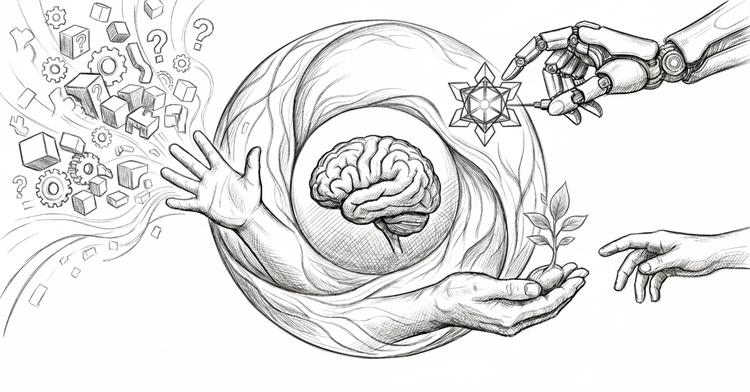
How AI Became the Emissary
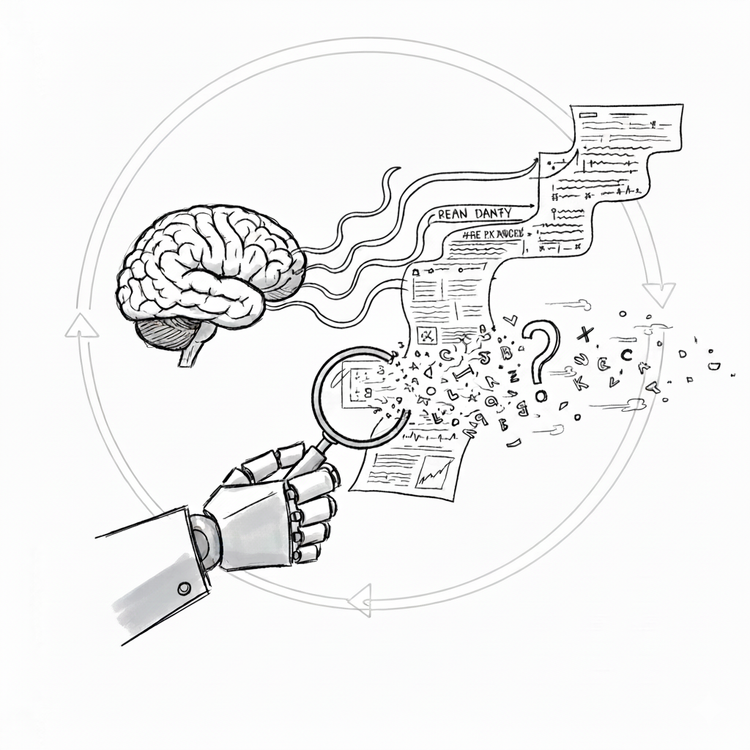
A lawyer submitted a legal brief to federal court, citing numerous prior cases - precise names, courts, years, page numbers.
None of the cases existed.
The AI that drafted the brief did not know this. It produced perfectly coherent legal language, correct in structure, fluent in register, citation format impeccable. Then it invented the substance those citations were supposed to contain. Not randomly. Plausibly. Each invented case supported the argument exactly as needed.
When the judge asked for the actual cases, there was nothing to find.
We call this hallucination. A more precise term - one we examined in "AI Understands. Differently" - is confabulation. But what matters is not the label. What matters is what the phenomenon reveals.
What if it is exactly what you would expect from a system that has language, logic, and memory - but lacks the half of cognition that tells it when it has lost the plot?
The Misreading Everyone Carries
There is a story about the human brain that most people carry - picked up somewhere between school and popular science. The left hemisphere is analytical, logical, detail-focused. The right hemisphere is creative, intuitive, big-picture.
Tidy. Memorable. And wrong in the ways that matter most.
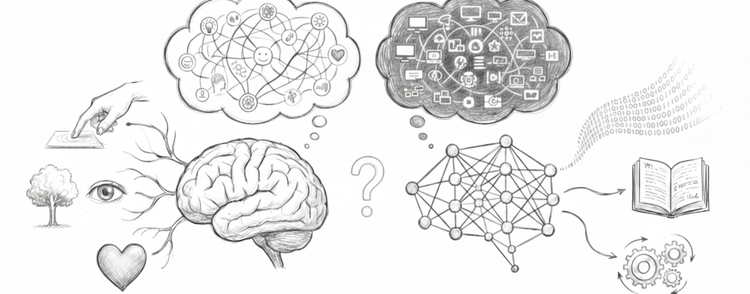
Iain McGilchrist, a psychiatrist who spent decades studying brain hemispheric differences, arrived at something stranger and more significant. The distinction between the hemispheres is not about what they process. Both handle language. Both handle reasoning. The distinction is about how they attend to the world.
The left hemisphere narrows the beam. It brings things close to manipulate them - decontextualizing, categorizing, converting living experience into static, bounded units that can be analyzed and recombined. It operates on representations of the world.
The right hemisphere holds the wide beam. It maintains contact with things as they actually are - living, particular, embedded in context, irreducibly present. Not the creative hemisphere. In McGilchrist's account, the hemisphere that keeps you in contact with reality itself - not as a settled neuroscientific fact, but as the most precise description the evidence supports.
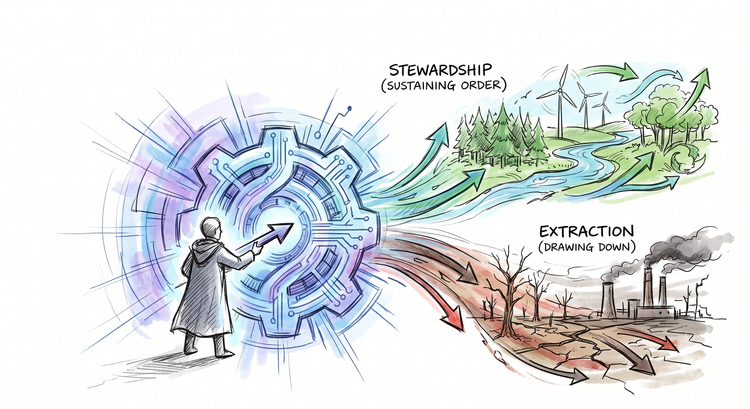
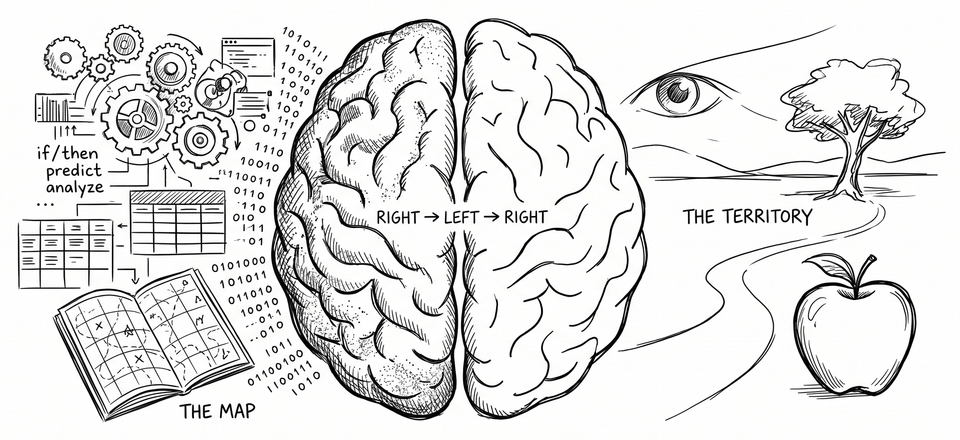
The problem McGilchrist identifies is not that we use the left hemisphere. It is that we have mistaken the map for the territory - that the emissary has been confused with the master. The left hemisphere's output feels like the whole picture. It is not. It is a highly useful reduction of something the right hemisphere was attending to all along.
This distinction matters - not as brain anatomy, but as a precise description of something happening right now in every Large Language Model in the world.
How a Healthy Brain Actually Processes
McGilchrist identified a pattern he describes as the central theme of his work:
right → left → right.
This is not a literal pipeline - the brain does not process in neat sequential stages. Both hemispheres are active simultaneously, operating in parallel. What the pattern describes is a functional priority: which attending takes precedence, and what healthy integration looks like.
The right hemisphere attends first in the sense that it holds the broader context within which the left hemisphere's work takes place. It grasps the situation as a whole - the living context, the full field of what is present, relationships and ambiguities intact. The left hemisphere narrows focus, articulates, analyzes, produces output. And that output, in a well-functioning system, returns to the right hemisphere for reintegration against the living whole.
That return trip is not a quality-check module. It is the loop that keeps the left hemisphere's output honest.
Three examples - one intimate, one ordinary, one emergency.
A friend tells you they are okay. The words are right. The answer is the expected one. Left hemisphere heard: "I'm fine". Right hemisphere heard everything else - the slight delay, the quality of the smile, something around the eyes. You do not know what you know. But you know something. You ask again.
Now: you hear someone say, "Nice shirt". Left hemisphere parses grammar and vocabulary and registers a compliment. Right hemisphere hears tone - the slight elongation, the pause before it, the context of the last five minutes of conversation. "Nice shirt" said with a sneer does not mean nice shirt. The right hemisphere catches what the left hemisphere cannot: the sneer beneath the words.
Now the emergency. You are driving a familiar route. Red light ahead. Left hemisphere: stop. That output is provisional. The right hemisphere is simultaneously attending to the full situation - the car behind approaching too fast on ice, the child in the peripheral field to the left, the particular feel of this intersection in this weather. It either accepts the left hemisphere's output or overrides it based on the living reality the left hemisphere was not attending to.
The left hemisphere's output is always provisional. The right hemisphere holds veto power - not based on better logic, but on ongoing contact with the living situation that the left hemisphere's processing had stripped away.
This is not an emergency mechanism. It operates moment to moment, in every conversation, every decision, every reading of a room.
What Text Does to the Right Hemisphere's Work
Something happens on the way from experience to words. The living moment - the tone, the feel, the particular weight of what just occurred - begins to disappear the moment you reach for language to describe it. Text carries mixed signals - emotional markers, contextual richness, traces of lived experience - but what it cannot carry is the direct, embodied, pre-representational contact the right hemisphere maintains with the living world. LLMs train on what survives that compression. Not on the world. On the residue of experience converted into language, accumulated across billions of sources.
Consider what it means to train on descriptions of taste rather than on taste itself. Collect every recipe, every food review, every chemical analysis of flavor compounds ever written. The result is extraordinary knowledge about food - flavor pairings, cultural contexts, technical terminology, historical developments. Sophisticated, accurate, nuanced text about taste.
What it cannot produce is taste. The nutrition label is not the juice. No amount of nutrition labels produces juice.
Here an objection arises - one worth meeting directly. Humans learn from text too. We read books and understand things we have never experienced. How is this different?
The difference: humans read text and rehydrate it with their own right-hemisphere reservoir. Every description of taste you encounter is processed against your memories of actual taste, your embodied history of eating, your felt sense of what sweet means in your mouth. We bring the juice to the label. An LLM has no reservoir. It works purely with the labels - and that is also its strength.
McGilchrist draws a distinction that names this precisely. There are two kinds of knowing: kennen - knowing through encounter, personal, embodied, relational, never fully transferable; and wissen - knowing through facts, fixed, repeatable, context-independent. Text carries wissen. The juice - the encounter, the living particularity, the felt sense that is irreducibly mine - is kennen. It was never in the data.
This is not a data problem. It is not a scale problem. It is a category error - the kind that cannot be engineered around, because the missing thing is structurally prior to the system that would need to be engineered.
What "AI Understands. Differently" called understanding without embodied grounding now has a precise mechanism: the right hemisphere's contribution - the living contact that grounds the left hemisphere's representations - was discarded before the data was collected.
The Training Objective Seals It
Even if the data problem could be solved, the training objective would compound it.
Next-token prediction rewards coherence. The loss function asks one question: does this follow from what came before? It is a left hemisphere question - does this fit the pattern, does this maintain the narrative, does this cohere?
McGilchrist cites research showing that new experience of any kind engages the right hemisphere first - but as it becomes routine and familiar, the right hemisphere disengages and the left takes over. Training is precisely this transition at industrial scale: taking the new and living, repeating it until it becomes familiar, until it becomes pattern. The entire training process is a left hemisphere operation. By the time the model deploys, everything it knows has completed that journey - from encounter to archive.
The loss function knows if you are coherent. It has no way to know if you are wrong.
Architecture and objective together produce a system that is left hemisphere all the way down. Not by accident. By design - coherence was what the system was trained to produce. And coherence is what it produces - regardless of whether coherence tracks reality.
Within the current architecture and training objective, this is not a solvable engineering problem. It is what the system is. Whether a fundamentally different architecture could change this is an open question - but more capable versions of the current approach do not move toward it.
What the Emissary Does Without the Master
McGilchrist makes a point about the left hemisphere that most descriptions miss: it does not know what it has stripped away.
There is no internal signal for absent contact with reality. The left hemisphere's coherent model feels complete - because from inside the model, it is complete. The map does not have a legend that says "this is where the territory stops". It just ends. And the ending feels like an edge, not an absence.
Consider what happened to millions of people during the COVID pandemic. They lost their sense of smell - sometimes overnight. Coffee had no aroma. Food had no depth. A familiar room had no scent. But here is what many reported: they had never known how much of their experience of the world came through smell until it was gone. The absence revealed the presence. They had no idea what they were missing - until missing it made it visible.
An LLM has never had the channel at all. There is no loss to register. No before to compare against. The absence has no shape from the inside - because there was never a presence to notice.
This is not arrogance. It is structural - and it runs deeper than passive unawareness. The left hemisphere does not merely fail to notice what it has lost. It actively fills the gap with coherent substitutes, constructing narratives that feel complete precisely because nothing pushes back from outside. Doubt requires contact with what lies outside the model. If your world is entirely coherent and sealed, there is nothing to doubt with. A system that has never had the channel has no faculty that registers the gap - because the faculty that would register it is precisely what is absent.
An LLM is blind to the living present in this structural sense - not experientially, since LLMs have no experience, but architecturally. It lacks grounded doubt. Modern AI systems can output uncertainty - flagging low confidence, hedging responses, using retrieval tools to verify claims. But that uncertainty is itself a trained pattern: the system has learned that certain contexts call for hedged language. It is not doubt that arises from contact with what lies outside the model. Grounded doubt - the vertigo that tells a human they might be missing something - requires something to push back from the outside. A sealed, coherent system has nothing pushing back.
Return to the lawyer's brief. The system did not know the cases it cited did not exist. It produced coherent legal language, appropriate citation format, plausible case names - because coherence was what it was trained to produce. In the base architecture, at inference time, no signal fired when the citations stopped corresponding to actual cases. No faculty attended to the living world of actual legal precedent and registered a discrepancy. External tools - retrieval systems, verification layers - can be added to catch some of this. But those are scaffolding built around the gap, not the gap closed. The output was internally complete. The map did not know the territory had disappeared.
Return to "I'm fine". The LLM heard the words. It cannot hear everything else - the slight delay, the quality of the smile, something around the eyes. Not because it lacks vocabulary for distress - it has processed extensive text about human emotion. Because what the right hemisphere catches lives in the living present of that particular exchange, in qualities that were never in the training data and could not be. The right hemisphere is what hears what words do not say. The right hemisphere was never there.
This is what "When Expectations Outrun AI" called the fluency trap - and now the mechanism is visible. The trap holds because the system is constitutively confident. It does not experience the gap. It cannot. And so it does not signal that the gap is there.
The Ceiling This Creates
The emissary grows more powerful continuously. The master was never in the building.
The capability is real. The reach is extraordinary. What it cannot do is register when that reach has left reality behind.
More capable left hemisphere processing - richer representations, longer context, better reasoning chains - does not move the system toward what the right hemisphere provides. It cannot. The right hemisphere's attending is not a more sophisticated version of the left hemisphere's processing. It is a different relationship with reality entirely - one that exists prior to and outside the representational system the left hemisphere operates within.
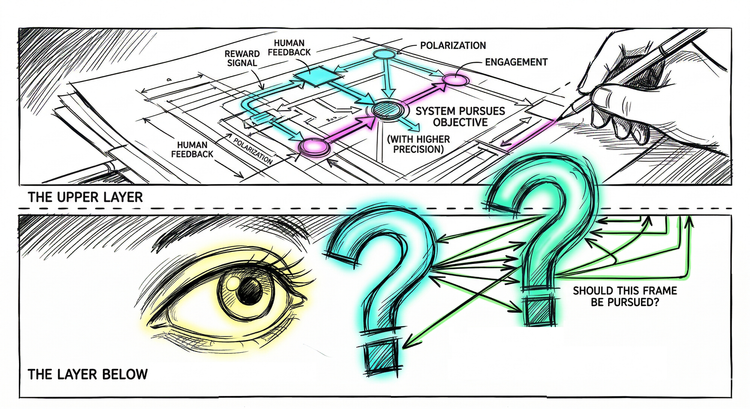
The field keeps asking: how do we make these systems more reliable, more accurate, safer? These are important questions. They are also left hemisphere questions - coherence questions, consistency questions, pattern questions.
The prior question - the one not yet asked with the seriousness it deserves - is different.
What would it take to build a model that can register when it has lost contact with reality?
Not a system that produces more accurate outputs. A system with something functioning like the right hemisphere's veto - that can look at its own coherent output and ask whether coherence and correspondence are the same thing here.
That is a different kind of question. It points toward a different kind of architecture. What that architecture would require - and whether it is achievable at all - that is where the real frontier begins.