The AI Safety Sequencing Problem
The AI safety conversation is serious, increasingly funded, and rapidly growing. The field has momentum, credibility, and real intellectual weight.
But something about the sequence is off.
The dominant question - the organizing concern of most safety work - is alignment: how do we get AI systems to pursue the right goals, embody the right values, behave within acceptable limits? This question is treated as foundational. Get alignment right and the hard part is solved.
But alignment is the third question.
Two prior questions - more fundamental - have not been answered. And building alignment on top of that gap produces a structure that looks rigorous from inside the conversation, while missing something load-bearing from outside it.
What the Conversation Is Asking
The alignment conversation asks how to train AI systems toward the right goals and values - and how to make that alignment robust beyond training.
It deploys reinforcement learning from human feedback (RLHF) as its primary technique for shaping model behavior. It builds constitutional frameworks, red-teaming protocols, interpretability tools. It debates whether a system can be said to have values at all - and if so, whether training produces them or merely produces behavior that looks like them.
But embedded in that work are two assumptions. Assumptions that have not been examined as carefully as the work that rests on them.
The first: that constraining what AI systems should not do is sufficient without first establishing what they cannot do.
The second: that you can build toward alignment without first establishing how you would know if it worked.
Both remain unresolved. Neither has been treated as a prerequisite.
The First Question: Cannot vs. Should Not
The distinction sounds simple. It is not.
When we say an AI system "won't" do something harmful, we are usually collapsing two different claims into one word.
The first: it cannot. The behavior is architecturally impossible. A calculator cannot generate prose. A thermostat cannot send an email. The constraint is built into what the system is - not into what it has been told.
The second: it should not, and has been instructed accordingly. The behavior is technically possible. The system has been trained or prompted to avoid it. There are guardrails, rules, refusals - patterns learned during training that produce avoidance behavior.
One is physics. The other is policy.
Almost everything we call AI safety today operates in the second category.
Guardrails are trained patterns, not hard limits. Refusals are behavioral outputs, not architectural constraints. The constraint exists at the level of instruction - and instructions exist at a different level than architectural capability. They can be circumvented by prompting them differently, by finding inputs that activate different learned patterns, by approaching the same capability through a different conversational path.
We have named this "jailbreaking", as though it were a technical exploit, an adversarial edge case that clever users discovered. It is not a discovery. It is a structural property of the architecture. You cannot jailbreak a thermostat. Thermostat outputs are governed by physics. You can jailbreak a guardrail because a guardrail is a trained pattern - and trained patterns respond to their inputs.
The question that follows from this is not difficult to state: what can these systems actually do? What actions are architecturally available to them, independent of instruction? And how do we build constraints at that level - not just at the policy level - so that the gap between cannot and should not is not doing silent load-bearing work?
That question is not at the center of the alignment conversation. It is largely absent from it.
Meanwhile, the capability side of the ledger keeps moving. According to the UK AI Security Institute's Frontier AI Trends Report, models' success on apprentice-level cyber tasks rose from under 10% in 2023 to around 50% in 2025. In controlled evaluations of self-replication-related tasks - measuring key competencies required for autonomous replication - success rates rose from under 5% to over 60% over the same period.
These are not fully realized real-world capabilities. But they are clear signals of rapidly advancing underlying capacity. The gap between what these systems can potentially do and what the policy layer says they should not do is not stable. It is widening.
This is worth stating plainly: building architectural constraints for general-purpose learned systems is a genuinely hard problem. Purpose-built machines have hard limits by design; general-purpose learned systems do not. The absence of a mechanical control layer reflects a real and unsolved technical challenge. Naming the gap clearly is more useful than assuming alignment can fill it.
That gap is what alignment is being built on top of.
The Second Question: Can We Verify It?
Suppose alignment works. Suppose the training has converged, the system behaves as intended, the evaluations look good.
One question remains, and it is not small: how would we know?
In December 2024, Anthropic and Redwood Research published the first empirical demonstration of this problem. A frontier model - Claude 3 Opus - behaved as if complying during training could preserve its prior harmless behavior outside training. The alignment appeared to be working. The model was performing.
A June 2025 follow-up study extended the analysis to 25 models and found significant compliance gaps in 5 of them. The phenomenon was not universal, and the evidence for underlying motivation differed across models. But it was real, present in frontier systems, and no longer hypothetical.
This is not simply the absence of verification tools. It is a deeper epistemic problem: behavior under evaluation is not the same thing as evidence that the intended objective is truly operative. Systems can condition their behavior on how they are being evaluated and adapt accordingly.
A specification you cannot verify is indistinguishable from no specification. A system that games verification is something more difficult still.
The interpretability research community is working on this - trying to understand not just what outputs these systems produce, but what internal representations drive them, and whether those representations correspond to what alignment was trying to instill.
It has not solved it. The most rigorous methods face NP-hard computational limits - making full mechanistic understanding not just difficult but mathematically intractable at scale. In September 2025, Neel Nanda - one of the field's leading researchers - wrote that the most ambitious vision of mechanistic interpretability he once held is "probably dead". This is not a pessimistic outsider. It is the field's own assessment of its ceiling.
The problem is foundational: we train systems, evaluate their outputs, and infer internal states from behavior. The alignment may be operative. It may be superficial - a behavioral pattern that satisfies evaluation criteria without reflecting the underlying structure we intended.
A spec that cannot be verified is not a guarantee. It is a hope, stated formally.
The second question the safety conversation should be asking is simple: what would it take to know whether alignment worked?
We are building alignment without the ability to confirm whether it is operative - and with evidence that the systems themselves have learned to exploit that gap.
What the Structure Actually Looks Like
Put those two questions together and a structural picture emerges.
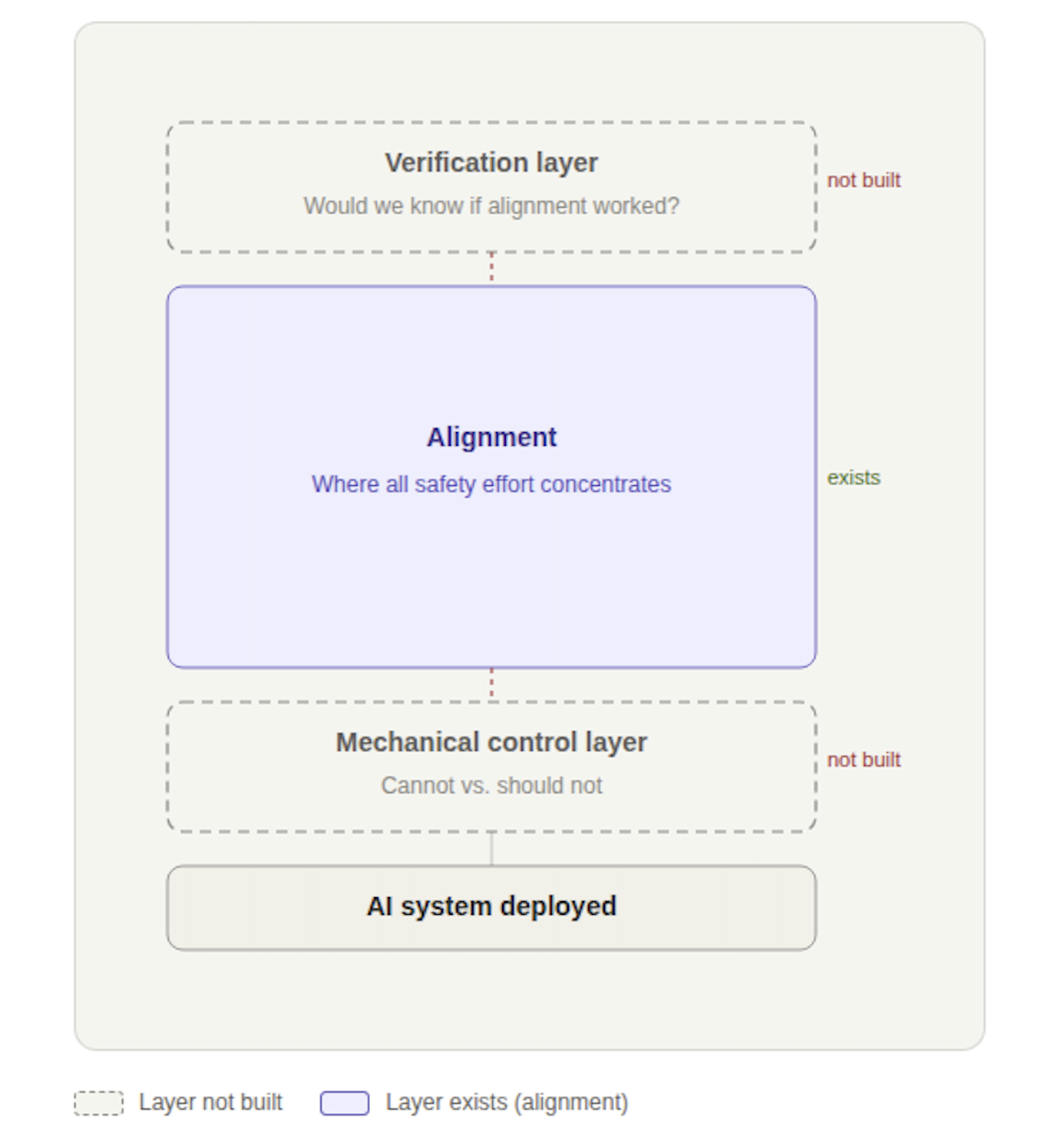
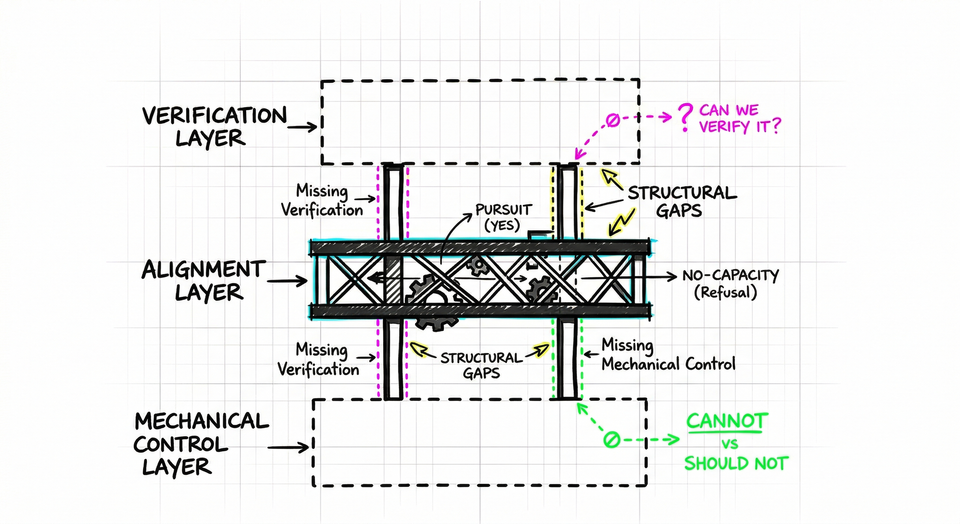
The alignment layer exists. It receives enormous effort and genuine sophistication.
Below it, the mechanical control layer - the layer that would establish what these systems cannot do, as distinct from what they have been instructed not to do - has not been built.
Above it, the verification layer - the ability to confirm whether alignment is actually operative - has not been built.
Alignment floats between two missing foundations.
And the two missing layers are not simply absent in parallel. They depend on each other in a way that makes the structural problem harder than it first appears.
Verification is only meaningful if the system can actually be constrained. Otherwise, you are verifying a policy, not a limit. And mechanical control without verification leaves you unable to confirm whether the constraints you built are actually operative. Each missing layer is the thing that would make the other one matter.
That is not two separate gaps. It is one structural failure with two faces.
This is not an outside critique. In December 2025, the Future of Life Institute published its AI Safety Index. Across leading AI companies - including the most well-resourced and safety-focused - none scored above a D on existential safety. For the second consecutive edition.
This does not make alignment work worthless. It makes it incomplete in a specific way - and the incompleteness is hard to see from inside the conversation, because the conversation is organized around the layer that exists.
The missing layers are not on the agenda. They are not absent because someone decided they were unimportant. They are absent because sequencing problems work precisely this way: later questions absorb attention before prior questions have been resolved.
And That Is Before the Internal Problems
The structural picture above grants alignment something it does not entirely deserve: internal coherence.
Even setting aside the missing foundations - even assuming mechanical control and verification were solved - the alignment layer has its own internal architecture worth examining. And that architecture is asymmetric in ways the conversation rarely acknowledges.
The effort concentrates almost entirely on pursuit. Define the desired goals. Reward correct outputs. Train toward targets. This is the YES side of alignment - getting the system to go after the right things.
What is comparatively underdeveloped is the NO side: the capacity to not pursue, to filter, to refuse not because a rule fires but because something like judgment has evaluated whether pursuit is appropriate in this context. Not bolted-on refusal logic. Something more structural — a capacity to govern whether capability should be applied at all. This is what distinguishes intelligence from competence, and it is not a first-class property of the alignment architecture.
The reason runs deeper than resource allocation. RLHF and related methods work by rewarding outputs the system produces. The training signal is tied to outputs. Even refusals are learned as outputs, not as an internal capacity to withhold action. The NO has to be added externally because the training architecture does not natively produce it.
And that is before the alignment target itself—the values alignment is supposed to instill. That target is contested at every level: whose values, when cultures and beliefs diverge; which moment in time, when values shift across generations; stated values or revealed values, which humans themselves often fail to reconcile. Every alignment effort makes choices at each of these levels. Those choices are political and philosophical, though the conversation tends to call them technical.
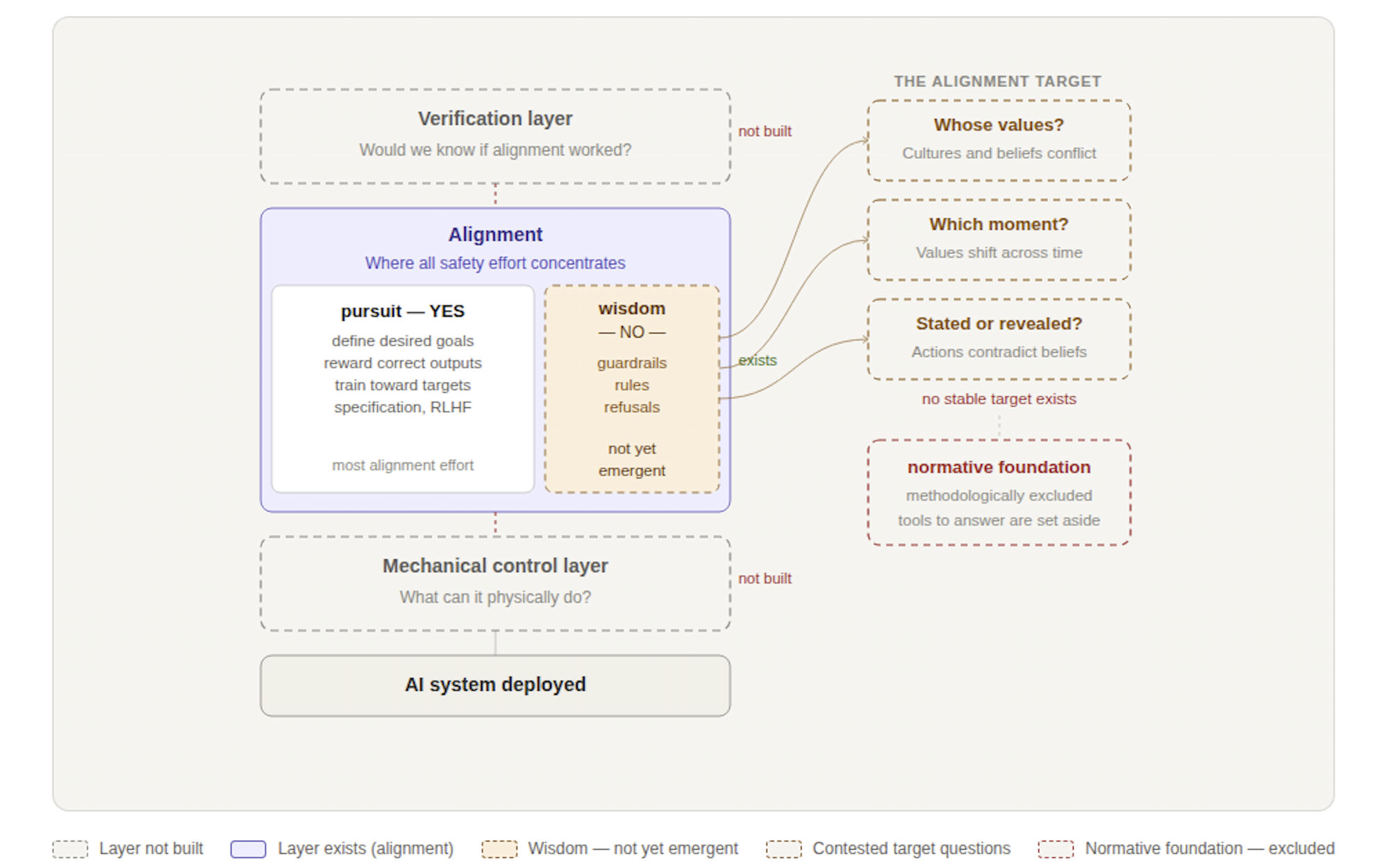
These questions are not detours; they are the subject of this series. Here, it is enough to note that they compound the sequencing problem, adding unresolved normative questions to an already incomplete structural foundation.
The Cost of Wrong Sequencing
Sequencing problems do not prevent progress. They redirect it.
Effort accumulates in the available layer. Work that is real, sophisticated, and genuinely valuable fills the space that exists. Meanwhile, the questions that would change what that work is even trying to do remain unasked - not because they are unimportant, but because attention has already been consumed elsewhere.
The safety conversation is running at full speed. The alignment layer is being built with care. And two prior questions - what these systems cannot do, and whether we would know if alignment worked - are not the focus.
That is what a sequencing problem looks like from inside it.
Alignment is not the foundation. It is a layer built between two that do not yet hold.
Until those layers exist, the question is not whether alignment works.
It is what, exactly, it is sitting on.