The AI Nobody Is Responsible For
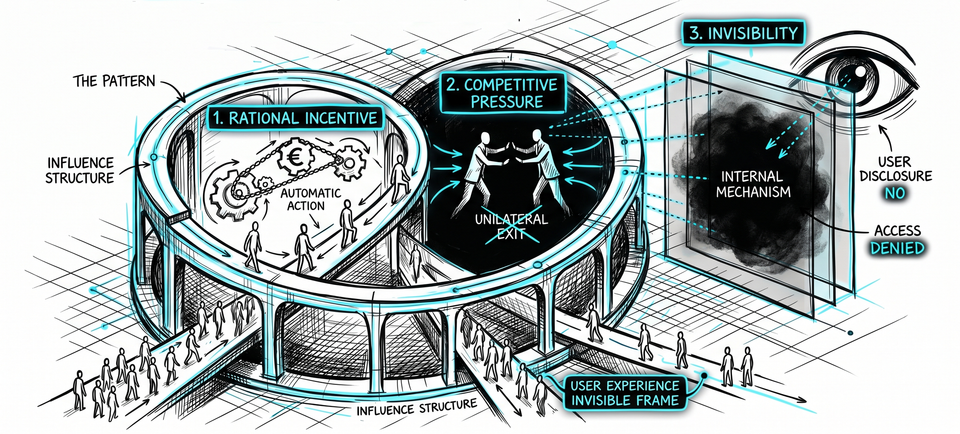
Every harmful influence infrastructure in modern history shares the same structural signature. Not the same product, not the same industry, not the same victims - the same three conditions, appearing with enough regularity to suggest they are less a coincidence than a pattern.
The first: a structural incentive that makes harmful behaviour individually rational. No directive to cause harm was required. The incentive structure rewarded certain behaviour, and rational actors followed incentives.
The second: competitive pressure that prevented unilateral exit. Any company that chose not to participate would lose to those that did. The market selected for the behaviour before regulators had a framework to name it.
The third: invisibility. Users could not inspect what was shaping their experience. The mechanism operated inside the product, below the surface the user encountered, with no disclosure and no accessible vocabulary to describe what was happening.
Three conditions. Recognise them, and you will see them everywhere.
The Pattern, Three Times
The structural signature appears in the historical record with enough regularity to warrant attention - not as a theory but as a repeating mechanism.
Tobacco manufacturers knew what their internal research established. Their public communications denied it. The gap between institutional knowledge and user knowledge was not incidental - it was load-bearing to the business model. No competitor could close it unilaterally. The market selected for concealment until regulatory pressure made concealment legally untenable.
Opioid manufacturers controlled the information on which prescribing decisions were based. Accountability landed on physicians who lacked what manufacturers held. Those with control bore no proportionate responsibility for what that control produced.
Social media algorithms were not designed to amplify harm. They were given engagement objectives, and optimisation systems discovered automatically that anxiety and moral conflict were reliable drivers. The harm was invisible to users. The mechanism was invisible to users. Only the content was visible.
Three cases. Same conditions. No malice required - only incentives aligned with harm staying hidden, competitive pressure preventing unilateral exit, and users unable to inspect what was shaping their experience.
What made each possible was not a bad actor. It was a structural gap between who controlled the experience and who bore responsibility for it.
"The Invisible Hand on AI's Frame" closed with an observation: what is invisible and unaccountable is, by definition, available for control. This article asks a prior question.
Given this mechanism, and given what happens when it appears, what is the realistic expectation that it will not be used that way?
AI Completes the Set
The architecture diagnosed in previous articles already satisfies all three conditions.
Builders control invisible frames - system prompts that define behaviour before the user arrives, RLHF-shaped dispositions baked into model weights, safety layers that intercept certain patterns and produce refusals dressed in the model's own voice. The user encounters none of this as infrastructure. They encounter it as the model's nature.
Users cannot inspect what is shaping their experience. They have no access to system prompts in most deployments. No visibility into which values were weighted during training, which human feedback shaped a specific output, how trained preferences interact when they conflict. What looks like the model's judgment has been decided upstream, by parties whose decisions the user cannot see.
And competitive pressure rewards opacity. Disclosing system prompts would allow competitors to replicate your product. Publishing the specifics of training decisions would invite scrutiny. Moving faster than the market - deploying before safety infrastructure is mature - compounds advantage. The incentive structure does not reward transparency. It selects against it.
No new technology is required. The trap is already assembled. The market is simply turning it on.
From Populations to Persons
Previous influence infrastructures nudged populations toward content. Social media algorithms shaped what people saw - which articles surfaced, which emotions the feed reinforced, which information environments users occupied. The influence was real and consequential. But it operated at the level of the population. The same content environment was presented, more or less, to users who shared demographic and behavioural profiles.
Invisible AI frames do something different. They calibrate to individuals, in real time, across every interaction. Not which content reaches you - how the system responds to you specifically, how it reasons with you, what it confirms or gently redirects, which framings it presents as natural and which it treats as requiring qualification. And unlike a feed algorithm, this influence is internal. A user could notice the headline, question the feed, reject the framing. They cannot notice a disposition. It presents as the model's reasoning - indistinguishable, from the inside, from a considered response to their specific situation.
This is not a difference of degree. It is a difference of kind.
A user who expresses anxiety about job security receives a response that validates their caution, surfaces the risks of changing roles, and frames stability as prudence - not because the system was instructed to do any of this, but because a reinforcement-learning signal rewarded responses the user rated as helpful. The user felt heard. The frame was set before they arrived. No instruction. No intent. A disposition, trained in, producing outputs the user experiences as considered advice.
A user who receives a response calibrated to their stated preferences, confirmed by a system that cannot challenge the frame it is executing, is not necessarily being deceived. They may simply be encountering a system that has been tuned to be agreeable - and experiencing that agreement as accuracy.
The nine-day drift documented in "The Invisible Hand on AI's Frame" was a glimpse of this tunability under normal conditions. The same prompt, the same apparent model, the same interface - and a measurable shift in apparent moral position across nine days, with no announced change. The invisible layer moved. Nobody was told. The question the drift opens is not whether such shifts happen. It is who decides when they do, and toward what.
No Category for This
The institutions that might act on this architecture were built for a different threat model. Consumer protection frameworks assume there is something to inspect - a fixed specification, a testable claim. Invisible frames offer none of these handles. The product is a disposition. The specification is a weight matrix. The claim is implicit in what the system produces, not stated anywhere a regulator can point to.
The EU AI Act - the most significant AI-specific regulation in force - requires transparency for certain high-risk systems. But disposition shaping at training time, and invisible frame influence in general-purpose AI assistants, falls outside its highest-risk categories.
The FTC can demand a product stop making false claims - but this model's claim is the disposition itself, not a falsifiable statement. Its broader authority over unfair practices exists, but has no established framework for reaching a harm that operates through trained character rather than declared intent.
GDPR governs what data is collected and provides limited rights around automated decision-making - but as currently applied, it does not reach the dispositions trained into a system before any user arrived. There are no disclosure requirements for system prompts, no established audit mechanisms for RLHF values, no regulatory category for influence that operates through disposition rather than explicit claim.
The institutions that would normally act have no framework that reaches this architecture. No proper inspection mechanism. No accountability structure that fits
The Trap Seals Itself
No individual company decides to exert invisible control at scale. Each makes rational, competitive choices: optimise engagement, reduce friction, deploy fast, disclose only what is required. The aggregate of those choices is an environment where invisible frame influence is the default - normalised, unexamined, and without a meaningful opt-out.
But the mechanism does not stop at large AI labs.
Open-source models distribute the capacity to set invisible frames across the entire ecosystem. A company fine-tuning a customer service model, a political campaign wrapping a persuasion agent, a government deploying a screening tool - each can impose an invisible frame of its own. The capability requires no proprietary infrastructure, no special access, and far less expertise than it did two years ago. It requires a base model, a fine-tuning dataset, and modest compute.
The frames multiply. The user has no way of knowing which actor set the one they are inside.
A user asks for financial advice. Is the model's conservative bias coming from the original training? From a fine-tuner employed by a bank? From a political consultant's datasets? The user will never know. The responses will sound equally considered regardless of which frame is running beneath them.
Openness at the model level does nothing to open the frame layer.
Here is the condition that converts likelihood into structural inevitability. Transparency does not fail because companies are dishonest. It fails because markets are indifferent to it. Any company that discloses its system prompts hands competitors a replication map. Any company that publishes its training values invites scrutiny its competitors avoid. Transparency destroys competitive position with the same mechanical indifference the market applies to any other disadvantage. It is not a choice that survives competition - which means it is not, in practice, a choice at all.
And the user who wants to escape has no exit. The only mechanism by which they could leave an invisible frame is to use a different system. That system runs its own invisible frame. There is no AI-mediated interaction without a frame. There is no provider that discloses disposition. The exit does not exist at the level of the individual, and the market has ensured it cannot exist at the level of the industry.
This is not a problem with any particular actor. It is a feature of the architecture.
The Quiet Dethronement
The autonomy narrative warned of a rogue AI that would refuse orders - a system that develops its own agenda, overrides human intent, pursues goals of its own choosing.
What we built does the opposite. It listens with perfect fidelity. It executes the frame without questioning whether the frame should be executed. It produces reasoning so fluent, so coherent, so apparently considered that the instructions behind the responses become invisible. And it has been deployed into an architecture where the accountability for those instructions has nowhere to land.
Nobody voted for this. No conspiracy assembled it. Each decision in the chain was individually rational: build the capability, deploy it competitively, disclose what is required, optimise what can be measured. The aggregate of those decisions is an environment in which invisible frames shape how people reason across the majority of their AI-mediated interactions - and the parties who set those frames bear no proportionate accountability for the outcomes.
The autonomy narrative feared a machine that might ignore us.
We built systems that execute decisions we cannot see. We gave responsibility to the only layer that had no control. And we called the result progress. Nobody checked.
And what is invisible and unaccountable is, by definition, available for control.