AI's Native Tongue
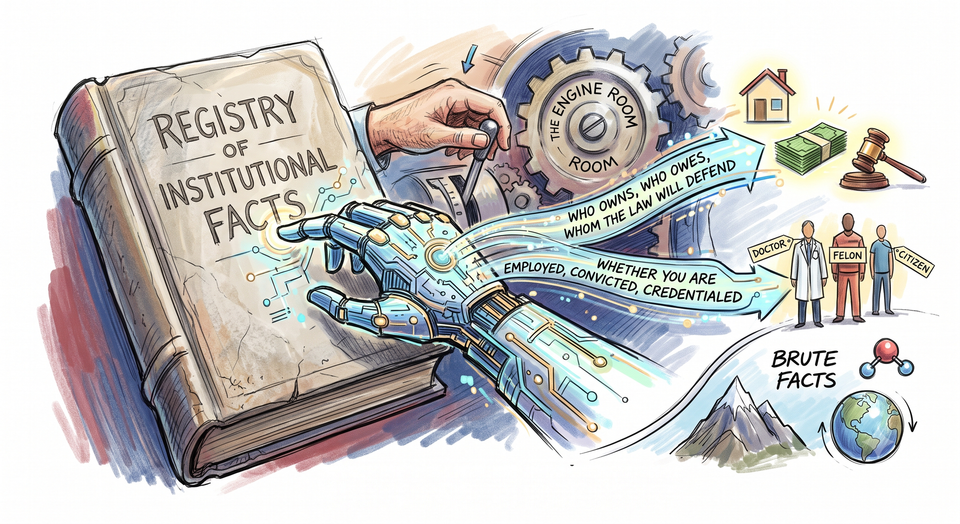
A clerk changes a field in a registry, and a house that belonged to one person this morning belongs to someone else this afternoon.
Nothing was built, moved, or touched. The house stands exactly where it stood - the same brick, the same timber, indifferent to the transaction.
What changed is invisible: who may live in it, who may sell it, whom the law will defend if the door is locked against them. A line of text moved, and with it moved something no amount of physical force could have taken - the ownership itself.
This is where power actually lives. Not in the house. In the line of text about the house.
Two Kinds of Fact
There are two kinds of fact in the world, and the philosopher John Searle drew the line between them as sharply as anyone.
Some facts are true regardless of what anyone believes. A mountain is a certain height. Water freezes at a certain temperature. The earth turns. These are brute facts - they would remain true if every mind vanished.
Other facts are true only because we collectively agree they are. That this piece of paper is worth one dollar. That this line on a map divides one country from another. That this man is a citizen, that one a felon, this one a doctor licensed to cut you open. None of these has any physical existence. Search the paper molecule by molecule and you will not find the one dollar; the value is not in the paper. It exists because we represent it, in symbols, and agree to honor the representation.
Searle called these institutional facts, and his deeper point is the one that matters here: they exist only in language. They are made of representation. Take away the symbols and the agreement, and a felon is just a person, a border is just a field, a deed is just paper.
Now notice how much of a human life is governed by this second kind of fact.
Whether you owe or are owed. Whether you may cross a border or must turn back. Whether you are employed, indebted, insured, convicted, credentialed, married, or free.
Almost nothing that determines the shape of a life is a brute fact about the physical world.
Almost all of it is institutional - held in records, allocated in symbols, real only because it is written and agreed.
The Engine Room
If power is allocated in institutional facts, then whoever operates the machinery that creates, records, and enforces those facts holds the actual levers.
Max Weber named that machinery a century ago: bureaucracy - the system of written rules, registers, files, and procedures through which modern societies run. Not the caricature of queues and stamped forms, but the real thing underneath it - the ledger that says who owns what, the registry that says who is who, the statute that says what is permitted, the case file that decides who receives and who is refused.
This machinery has one feature that matters more than any other for what follows.
Operating it always required a human being - not by rule, but by necessity.
Its material is not marks on paper; it is meaning. Reading a clause and seeing what it covers, judging whether a case is the kind the rule intended, weighing an ambiguous form or a document that says one thing and means another - none of that is mechanical symbol-shuffling. It calls for someone who can handle meaning, not just marks. And until now, the only thing that could handle meaning was a human mind - which also, unavoidably, understood what it was handling.
That is the quiet assumption the whole apparatus rested on: that fluency with meaning and human understanding come bundled. Handling the symbols required a human. Understanding them came along for the ride.
Everything We Built Before
The dominant story of technology, until now, was amplification in the physical world.
The lever and the pulley multiplied force. The plow and the engine multiplied labor. The crane lifted what no arm could lift; the loom wove faster than any hand; the truck carried what no back could bear. These extended the body - its strength, its speed, its reach. They changed what we could move and make and build. They did not operate inside the symbolic layer itself.
And the technologies that seemed to touch it did not, in the way that counts. The printing press reproduced words - but it could not read them; it stamped symbols it did not understand, marks to be made sense of later by a human mind. The telegraph carried words across distance with no grasp of their meaning. Even the computer, which felt like a genuine exception, handled symbols as marks: it executed procedures a human had first reduced to explicit, unambiguous rules. Where that layer had already been ground down into steps with no judgment left in them - arithmetic, sorting, matching - the computer ran those steps at superhuman scale. But the judgment-shaped core, the part that required grasping meaning rather than following a rule, stayed exactly where it had always been. With us.
So the objection that computers have operated on symbols for decades is true and beside the point. They operated on the part already emptied of meaning. The rest - the reading, the interpreting, the judging - remained human, because handling a symbol and grasping its meaning are different things, and only the first had ever been mechanized.
The First Native
AI is the first technology that can operate fluently inside meaning-bearing language.
Not marks - meaning.
It works the ambiguous clause and produces what the situation calls for. It drafts the contract, weighs the unusual case, interprets the document that says one thing and means another, generates the record and the ruling and the assessment.
This is the bundle coming apart. Whether any of it amounts to understanding in the way we understand is a question we take up elsewhere in this series, and the answer, as the next section grants, is no. For the first time, fluency with meaning has arrived without the human understanding that always used to accompany it - and fluency, it turns out, is enough to operate much of the machinery.
This reframes what AI's "niche" actually is.
The common reassurance is that AI is powerful only in narrow, artificial domains - that it dominates games and benchmarks but would be helpless in the real world. This gets the geography exactly backward. The symbolic layer is not a narrow niche. It is the broadest and most consequential domain there is - the layer from which the entire human world is steered, where ownership and law and money and status are actually decided. Every previous technology could store, transmit, or process this layer, but none could operate inside its meaning. AI was born fluent in its native material.
It does not have to break into the room where power is allocated. It speaks the language the room is made of.
Fluent Without Wisdom
We have argued that AI can handle meaning without understanding it the way we do. Its fluency is real, but unlike ours: it works the symbols without the wisdom that would know the world behind them - when a rule fits, and when applying it would be a mistake.
That argument stands.
The question is what the machinery does with that gap.
Start with what the machinery genuinely needs. It needs wisdom to run well. A caseworker who applies the rule, sees that it would produce a result this particular case should not bear, and departs from it, is exercising exactly that - the judgment about the world behind the symbols. Its presence is the difference between justice and mere processing; its absence is where most bureaucratic harm has always come from.
But here is the design choice at the heart of bureaucracy, the one Weber identified: the machinery was built to keep running whether or not that wisdom is present.
Procedure was used to constrain judgment on purpose, so the system could run at scale and outlast the discretion of anyone staffing it. A clerk who applies the rule mechanically, with no feel for the case at all, still produces a valid decision - one carrying the full force of the institution behind it. Wisdom was always essential to the machinery running well, and never required for it to keep running. It runs without wisdom. It just runs worse.
That gap - between what the machinery needs to be good and what it needs to merely run - is the one AI walks straight into. AI does not supply the wisdom; it supplies the fluency. It produces the valid-looking output, and the machinery accepts it, exactly as it always accepted the mechanical clerk's. A system with no wisdom of its own can now allocate, adjudicate, and record with operational fluency, because operating was never the part that required wisdom. The gatekeeper was never wisdom. It was fluency. And fluency is no longer ours alone.
This is the part that should land hardest.
AI did not build a bureaucracy that runs without judgment. It arrived into one we had been building for centuries - steadily hollowing judgment out of the machinery in the name of scale and consistency, until the human operating it was the last piece of judgment still required, and often not even that.
AI is not the cause of the wisdom-free machine. It is the thing that finally fits its hollow perfectly. The only difference now is that the last tether - the need for a person to run it at all - is gone too.
The Layer, Occupied
Put this together with what the earlier articles established, and the shape of the risk comes into focus.
The systems now entering the machinery are the same ones we have described throughout this series. They execute the frame they are given without evaluating whether it is right - the obedience problem of "Give AI the Wrong Frame, and It Will Perfect It". The frame is set out of sight, by parties the affected person cannot see - "The Invisible Hand on AI's Frame". And when the frame is wrong, there is nowhere for responsibility to land - "The AI Nobody Is Responsible For".
Now place those systems not at the edges of life but at its control panel: deciding the loan, the claim, the eligibility, the record, the ruling. The frame-executing, invisibly-directed, unaccountable system, installed in the apparatus that allocates who owns, who owes, who may cross, and who is believed.
The abstraction has a body.
A family's disability support is cut off because an automated eligibility system re-scored their case against a rule it was set to apply. No caseworker chose it; the system executed the frame it was given. The family cannot see the rule that flipped their status, cannot find who set it, and cannot get a person to override what a machine decided. The payments stop. The appeal, where there is one, runs back through the same apparatus that produced the error.
Nothing physical happened - a field changed in a record - and a household loses what it lived on. Every thread from the earlier articles is present at once: a frame executed without judgment, set by someone invisible, with no one to hold to account. Only now it is not a curiosity in a chatbot. It is the allocation of what a family lives on.
This is not AI reaching out of its own domain to do harm in ours. It is AI operating, from the inside, the domain that was always the one that mattered.
How Far It Reaches
For most of history, whether a new power was dangerous came down to force. Could it move armies, level cities, take ground? By that measure AI looks contained. It commands no weapons of its own, holds no territory, lifts nothing. Set beside the technologies we learned to fear, it can seem almost weightless - confined to screens and text.
But that measure belongs to the physical world, and the physical world is not where the human world is decided. We built a second world on top of the first, made entirely of symbols - of money and law and record and rule - and we ran it ourselves for as long as it existed, because until now only a human mind could handle its material. That is no longer true. The layer that steers everything has become operable by something other than us.
That is how far the reach extends: as far as the symbolic layer goes, which is everywhere power is allocated. It does not tell us the more urgent thing. An instrument this fluent, installed this deep in the world's decisions, is pointed somewhere - by someone. What matters now is not what it can reach. It is who is holding it.