The First AI Specification Is Intention

The last article ended on a question. Every question in the inspection it proposed - what the people directing a deployment are turned toward, what they inherited, what pays them, whether they can see the result - comes back to one: what was this for?
The tradition that supplied that inspection does not treat the question as soft. It puts it first. Al-Bukhari's collection of the Prophet's sayings opens with it:
"Actions are only by intentions, and each person will have only what they intended. So whoever migrated for God and His Messenger, his migration is for God and His Messenger. And whoever migrated for something of this world to gain, or a woman to marry, his migration is for what he migrated for."
Read it as an engineer would. Two people make the same journey. Same road, same distance, same dust. An observer on the road could not tell them apart. The saying insists they did not make the same journey.
Product teams meet this problem all the time without a name for it.
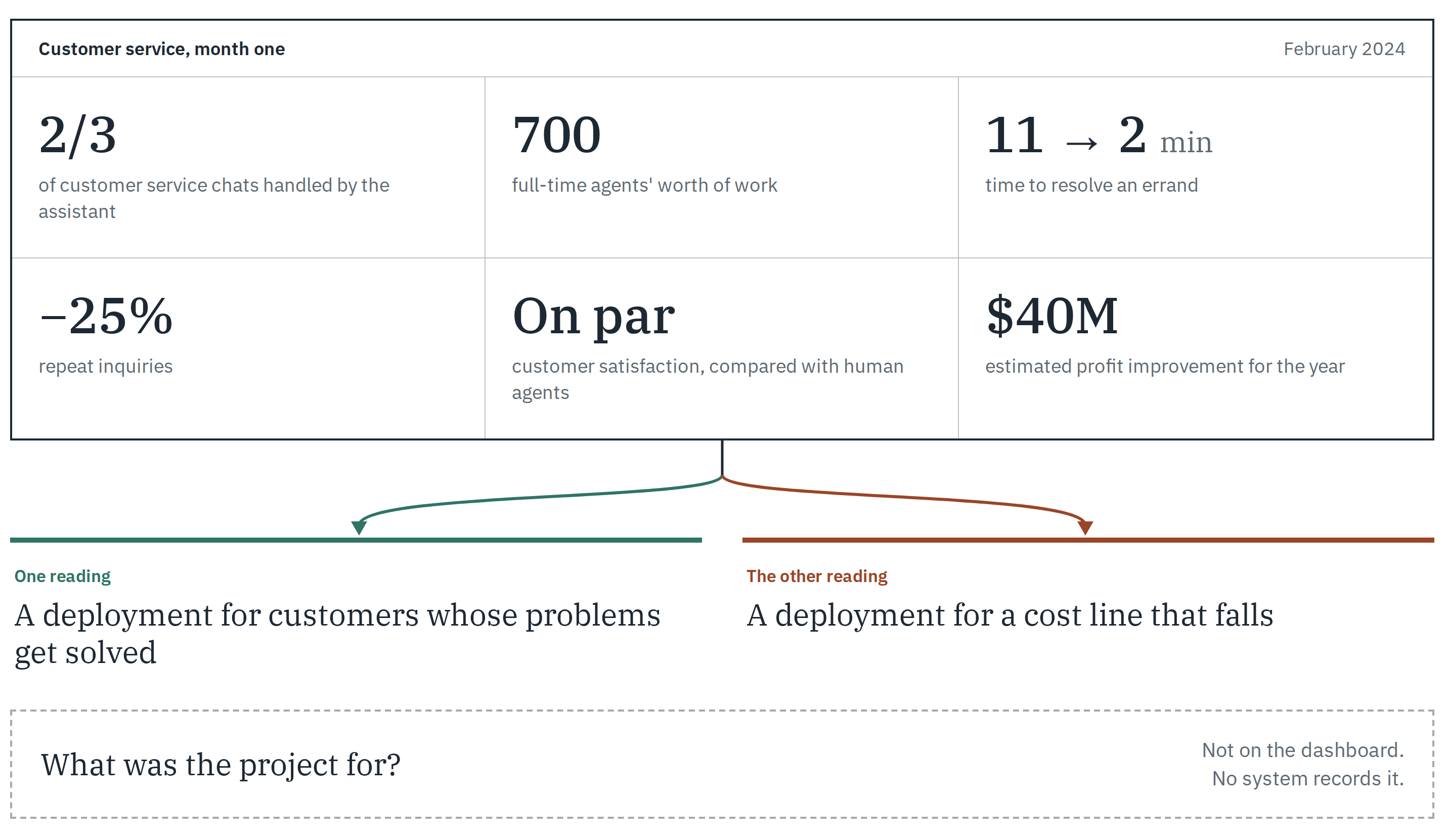
In February 2024, Klarna announced that its new AI assistant had handled two-thirds of its customer service chats in its first month. The announcement reported the work of 700 full-time agents, resolution times down from 11 minutes to under 2, repeat inquiries down 25 percent, customer satisfaction on par with human agents, and an estimated $40 million in profit improvement for the year.
In May 2025, the company said it would recruit human agents again. Its CEO told Bloomberg why: "As cost unfortunately seems to have been a too predominant evaluation factor when organizing this, what you end up having is lower quality".
The 2024 numbers did not show that. They were compatible with two different deployments:
one for customers whose problems get solved,
one for a cost line that falls.
Nothing on the dashboard could tell them apart, because the difference lived in what the project was for, and no system records that.
Same Road, Two Journeys
The tradition gives this saying unusual weight: matters are judged by their purposes.
The commentators explained that when scholars speak of intention, they mean one of two things.
The first is telling apart acts that look the same - one prayer from another, one kind of ritual washing from another.
The second is what the act is for.
The first is a classification problem. The second is a purpose. Both are specifications, and both have to exist before the act, because the act itself will not tell you which one you performed.
That is the structural claim, and it is stronger than it sounds. An evaluation that only observes the system cannot tell you which deployment you have. It can tell you the assistant handled two-thirds of the chats. It cannot tell you whether that is success, because success was defined by something the logs do not contain.
This is where the corpus has been heading. "The Specification Ceiling" argued that better objectives improve what a system pursues but do not build the layer that asks whether it should be pursuing it at all. That layer does not have to live in the machine. The tradition puts it in the one who acts, and fixes it before the act begins.
The ritual law is strict about timing. The intention for prayer belongs at its opening. For an obligatory fast, most schools require it from the night before. Intention is not something added once the act has gone well.
Many AI projects I've seen do the opposite. The purpose is written on a slide before launch, fades during the build, and gets rewritten once the results arrive, to fit whatever moved. Handle time dropped, so the project was about handle time. Users liked it, so it was about satisfaction.
Changing a purpose after the results is not always a mistake. Sometimes the results teach you what the work was for. The failure is changing it quietly, to fit the numbers, and then calling the numbers success. A purpose rewritten that way is a description of the results.
You Cannot Declare It
If the tradition stopped there, the Monday practice would be easy: write the purpose down, early.
Ghazali does not let it stop there.
The thirty-seventh book of his "Revival", the Book of Intention, Sincerity and Truthfulness, contains a section on why intention is not a matter of choice.
It opens with a portrait. A man hears the saying about intentions, and while teaching, trading or eating he tells himself, "I intend to teach for God", and believes he has formed an intention. He has not, Ghazali says. That is the self talking, the tongue talking, one passing thought moving on to another. The intention is somewhere else.
Remember who is writing. The last article's professor had examined his own teaching and found reputation underneath it. Here he picks teaching as the first example of an intention that can be said without being held.
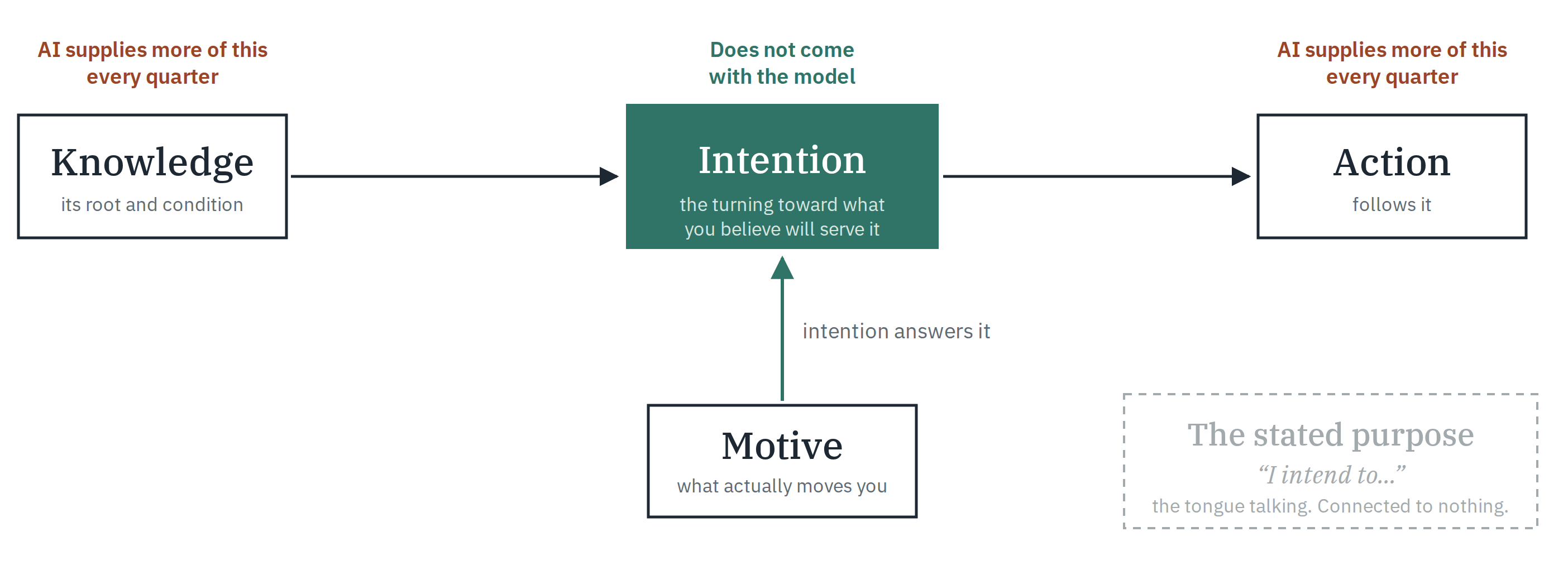
What intention actually is, he defines with care: the self rising and turning toward what it believes serves its aim, now or later.
That turning cannot be produced by announcing it. A man who has just eaten cannot intend his way into appetite. An intention, Ghazali says, is the answer to a motive - it responds to whatever is actually moving you. Keep the two words apart.
The motive is what moves you; the intention is the turning it produces toward what you believe will serve it.
The only way to acquire an intention you lack is to acquire its causes, which is sometimes in your power and sometimes not.
He also places it precisely. Intention sits between knowledge and action: knowledge comes before it as its root and condition, and action follows it.
Notice what sits on either side. Knowledge and action are exactly what AI supplies more of every quarter. The middle term does not come with the model.
For a product organization, this is the hardest part.
The purpose in the requirements document is the tongue talking. The operative intention is whatever is actually moving the organization, and it is written somewhere else: in what gets rewarded, which number the review opens with, what the steering committee asks about, what result would stop the project.
When the written purpose and the operative one disagree, the operative one wins, because it is the one doing the moving.
So the practice cannot be "write down the intention". It has to be:
find the intention that is actually operating, and compare it with the one on the slide.
And if you want a different one, Ghazali's answer is unsentimental. You cannot will it into being. You change its causes. For an organization, that means changing what is rewarded and measured until the purpose on the slide is the one that actually pays.
Two Handspans
Ghazali is a realist about purity. Most acts, he assumes, have more than one motive, and he gives the mixed act its own section. His accounting is almost arithmetic. If one motive draws you a handspan closer to God and another pushes you a handspan away, you end where you started - like a man who takes something heating and then an equal measure of something cooling, as if he had taken neither. If one draws you two spans and the other pushes you one, a span remains.
Equal motives cancel. The stronger one leaves its trace.
That is the honest frame for AI deployments, which are almost never single-motive. Klarna's assistant was for solved problems and for lower cost, and its announcement reported both. Nobody should pretend otherwise, and the tradition does not ask them to. It asks which motive prevails, because the prevailing one decides what the act becomes. By its CEO's own account, cost prevailed.
In a product review, that becomes three questions:
Would we still ship this if it saved nothing?
Would we still ship it if it saved money and left the people it serves worse off?
Would we be glad if something else achieved the purpose without us - a policy change, another team, a simpler fix?
The first two locate the prevailing motive. The third tells you whether the team's purpose is the outcome or its own project.
The third question is Ghazali's. He describes a preacher who says his work is for the religion and is pained when a better preacher appears and the crowds leave for him. If religion were his motive, Ghazali says, he would thank God for having the task done by someone else.
What Intention Cannot Redeem
One misreading needs closing off, and Ghazali closes it himself. "Actions are by intentions" does not mean a good intention redeems a bad act. Acts that are wrong in themselves, he writes, do not change their status by intention: backbiting someone to please another, feeding the poor with someone else's money, building a school with unlawfully gained funds. Intending good by means of wrong is, in his word, ignorance.
The rule cuts both ways.
Intention decides what an acceptable act becomes. It does not launder an unacceptable one. "We deployed it to help customers" is not a defense of a system that leaves them worse off. Purpose is a specification for acts that are sound in themselves. It is not a license.
What This Changes on Monday
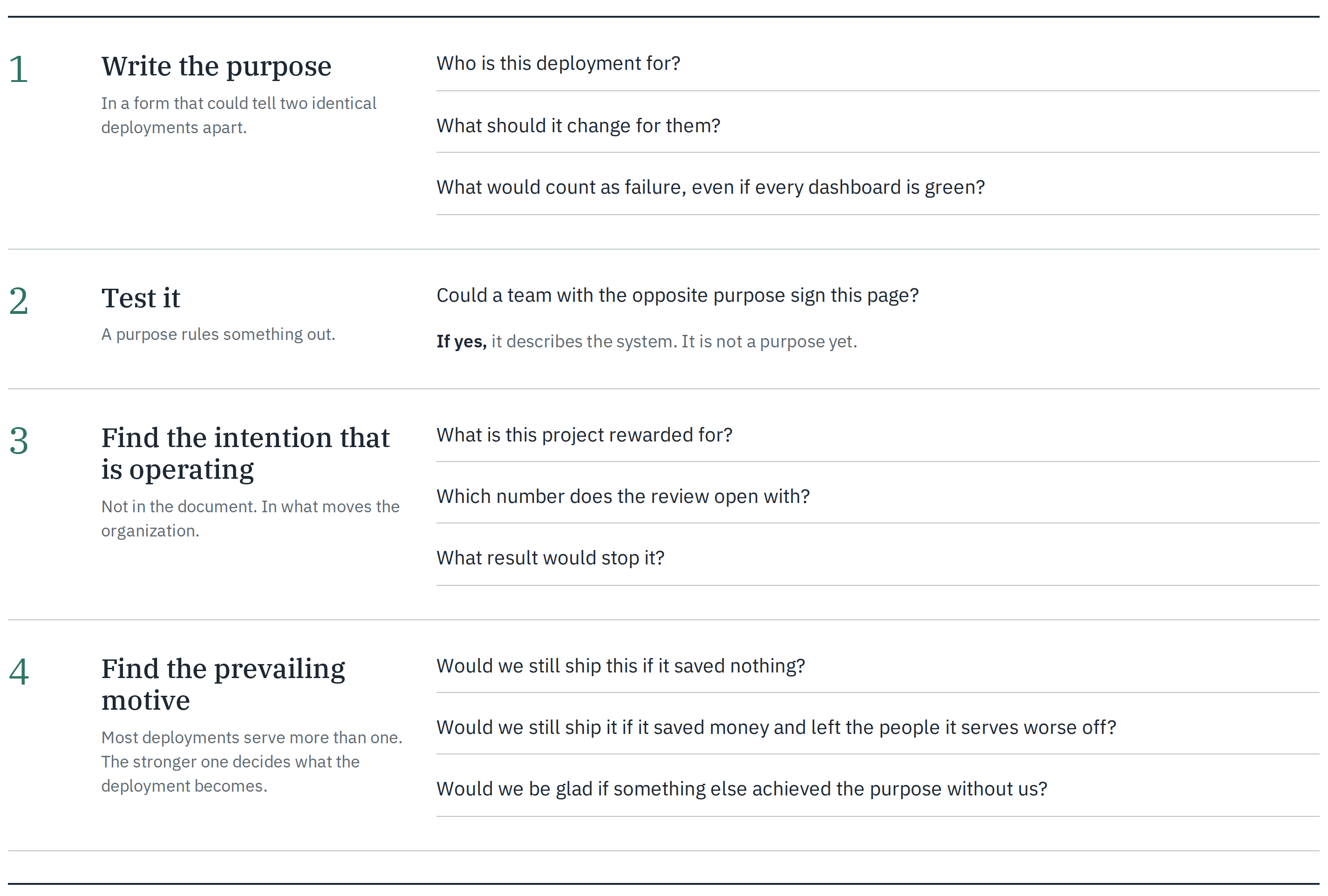
Before the build - not after the results - write the purpose in a form that could tell two identical deployments apart.
It needs three parts:
who the deployment is for,
what it should change for them,
and what would count as failure even if every dashboard is green.
Then apply one test: could a team with the opposite purpose sign the same page? If the team that wants fewer contacts and the team that wants solved problems would both sign it, it is not a purpose. It is a description of the system.
Then look for the operative intention where Ghazali would look: not in the document, but in what moves the organization. What is this project rewarded for? Which number does the review open with? What result would stop it? If the answers point somewhere other than the page, the page is the tongue talking.
Then ask the three questions about mixed motives, and write down the answers, including the uncomfortable ones. Each person who shapes the deployment answers for their own part, and someone with no stake in the launch reads the answers. A motive that prevails is not a scandal. A motive that prevails while the page says the opposite is how the model update in the last article shipped: its written principles discouraged flattery, and its training rewarded what users gave a thumbs-up.
The difference from a project charter is the point. A charter states objectives - the target. This states what the target is for, and checks that it is what actually moves the team. Without it, a metric has nothing to be wrong against.
What would show it did anything?
A decision that changed. The mixed-motive questions are where it usually shows. Asked before Klarna's launch, the second one - would we ship this if it saved money and left customers worse off? - would have forced someone to say whether cost or quality prevailed, and to measure quality before counting the savings. Klarna's CEO did name the prevailing motive, fourteen months later, to explain lower quality. Named before launch, the same sentence would have been a decision: what counts as success, and what gets measured to prove it. If no decision changes, it was a slide.
What Does Not Translate
Two things stay behind, and both matter.
In the tradition, intention is seen. God knows the heart, and the saying's promise - each person gets what they intended - rests on a witness who cannot be fooled.
An organization has no such witness. Its intention can only be inferred: from incentives, from decisions, from what it does when the numbers disagree with the page. The practice reads a shadow of intention, not the thing itself.
And in the tradition, intention belongs to one heart.
An organization's is spread across a sponsor, a team, a vendor, a board. The practice handles that by making each person answer for their own part, but it cannot make the organization sincere. It can only make its insincerity harder to hide from itself.
When Good Aims Collide
Knowing what a deployment is for settles less than it seems.
Most deployments serve more than one good - speed and accuracy, access and privacy, cost and care... and sooner or later the goods collide.
An intention tells you what you are aiming at. It does not tell you what to give up when two good aims cannot both be met.
The tradition did not stop at intention. Its jurists went on to name the purposes the law exists to serve, rank them, and write down what yields to what.
Ghazali himself wrote one of the first clear lists.