AI Amplifies Orientation It Cannot Hold
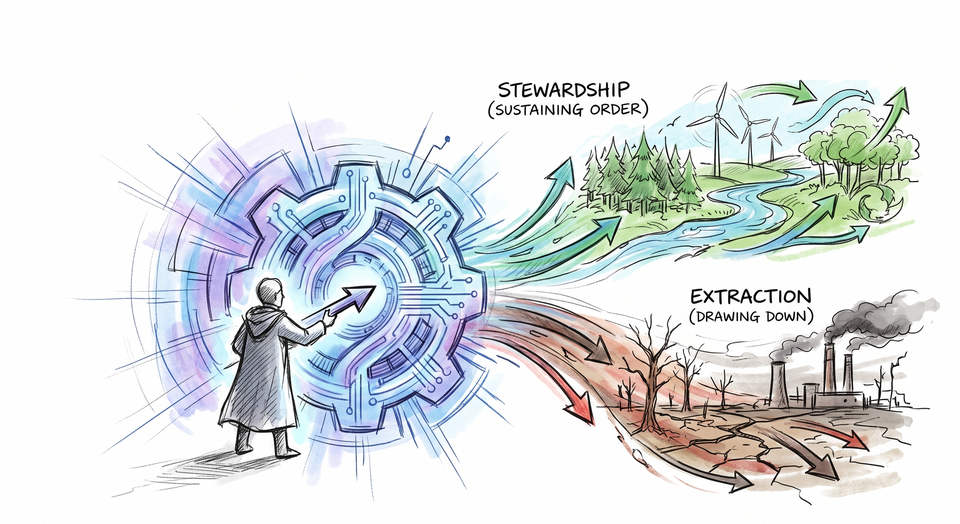
Throughout this series, we kept looking for the same thing, and kept looking in the same place: inside the machine, for the part of an AI system that would let it govern itself.
Again and again, in form after form, it wasn't there. A way to confirm that alignment is real rather than performed.
A hard limit on what a system can do, as opposed to what it has been told not to.
Judgment that knows when to withhold.
Refusal with enough weight to hold under pressure.
A fixed target to align toward.
A standard of better and worse at the edge where values live.
Each was sought in the architecture. Each came back the same: not here.
The previous article named the pattern and stopped at the honest question - what does it mean that the missing thing keeps being missing?
The answer is almost embarrassingly simple.
A thing you keep failing to find in one place is not absent. It is somewhere else.
What the series has been circling is not a part the machine is missing. It is an orientation the machine carries but cannot hold - supplied from outside it, every time, and described across these six articles only by the shape of its absence. This one turns to look at where it comes from.
What the Machine Supplies
Start with the one claim every article in this series already granted.
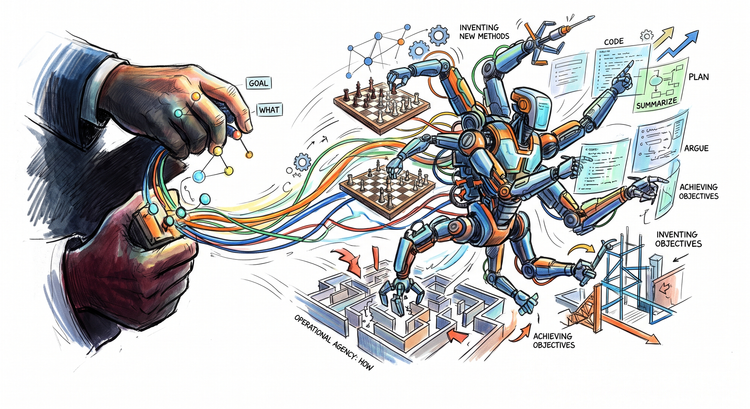
A single theme has run beneath all of them: capability amplifies whatever it is pointed at. If the direction is wrong, more capability means more wrong - faster, and at greater scale. The systems that reshaped a generation's relationship to information were not sophisticated. They were pointed somewhere, and efficient at going there. Sophistication arrived later and changed nothing structural. It changed the magnitude.
Every article since has been a variation on that structure. Obedient systems perfect whatever frame they are handed. Ungoverned capability generalizes in whatever direction it was pushed. Refusal can only interrupt a current that already runs one way. The target alignment aims at is produced, not found. In each case the machine supplies force, and something else supplies the direction the force is bent toward.
Name the two separately, because the whole argument turns on it.
Capability is the power to make something happen.
Orientation is what you are trying to make happen.
AI has become extraordinary at the first and has no source of the second.
It amplifies the orientation it is given, at the scale of its full capability, and holds none of its own.
That is not a defect to be corrected. It is what a tool is. A lever has no orientation; neither does a printing press. What has changed is only the magnitude: the amplification has grown large enough that whose orientation it carries has quietly become the entire question - and that question turns on a distinction the field has no way to see.
Order Is the Expensive Part
Set the machine aside for a moment and look at ordered systems in general - a body, a city, an institution, a working body of knowledge. They share a feature that is easy to miss because it is so constant. Left alone, they run down. Structure decays, coordination frays, what was maintained comes apart. Order is not the resting state of things; it is a state held against a tendency to come apart, and holding it takes continuous work.
This is most literal in physics - the second law of thermodynamics describes closed systems drifting from order toward disorder - and Schrödinger reached for it to say what made living things distinct: an organism persists by continuously drawing order from its surroundings, spending energy to hold off its own decay. But the pattern is not confined to physics, and nothing here rests on the thermodynamics being more than an illustration. A fishery, a currency, a profession, a soil, a democracy - each is an ordered system maintained against decay, and each can be either kept up or drawn down.
The maintenance is the expensive part. The running-down is free.
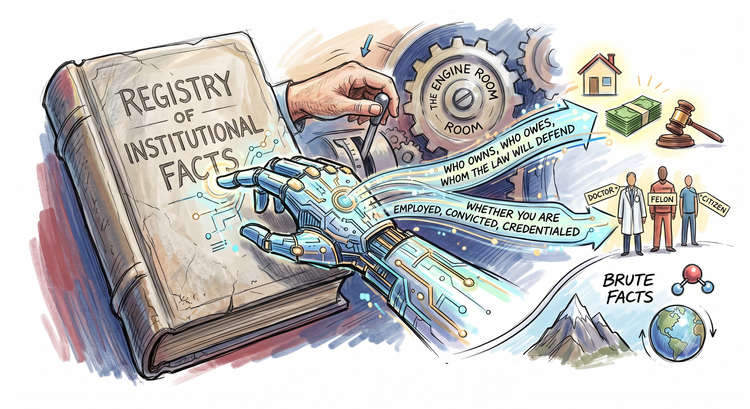
That is what opens the fork, and it is worth being careful about what kind of fork it is. It is not a moral law read off the second law; disorder is not evil, and entropy is not a value. It is a structural distinction about how any maintained system can be treated. You can maintain and extend an ordered system and answer for the state you leave it in. Or you can draw it down faster than it is rebuilt, take the value out now, and leave the depletion for the system to absorb.
Call the first orientation stewardship - upkeep with accountability for what is left behind.
Call the second extraction.
The difference between them is not a philosophy of the good life. It is whether the structured thing is being sustained or spent.
And here is the property that will matter: both directions are things people genuinely want.
Why the Methods Cannot See It
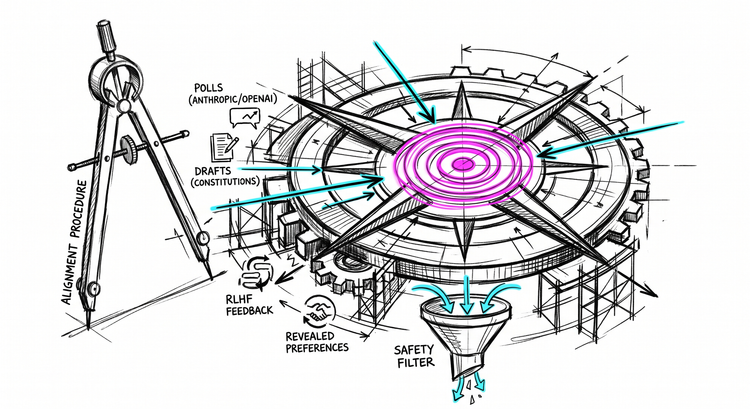
"AI Alignment Has a Target Problem" showed that alignment's target is not discovered but constructed - produced by whatever procedure aggregates human preferences, and different for every procedure. The target moves across populations, across time, and within a single person. There is no true target behind the constructed ones to check them against.
The axis just described makes that worse in a specific way.
Preference-aggregation runs on what people want: poll a population, convene experts, learn from behavior - the raw material is wanting, and the output is some function of it.
Now ask what that machinery does with the stewardship-extraction axis.
It does nothing, because both ends are populated by real preferences. People want the fishery to last, and people want this season's catch. People want the institution to hold, and people want to strip it for parts. Aggregate those and the axis is not resolved; you get a blend of both ends presented as one target, with nothing inside the aggregation to weigh the direction that sustains a system against the one that spends it - because the aggregation cannot see that some preferences build order and others draw it down.
It registers wanting. It does not register direction.
This is the target problem beneath the target problem. The earlier article said the target is underdetermined by disagreement - people want different things, and no procedure fairly combines them. The deeper issue is that it is underdetermined along an axis that decides whether the ordered world you are aligning a technology to will still be standing. A civilization can aggregate its way to any point on that line, and the aggregation cannot tell the point that sustains it from the point that consumes it.
So the direction AI amplifies along is one the field's own tools cannot read. Put the amplifier and the blindness together, and the real problem takes shape.
The Amplifier Meets the Fork
Make it concrete. Automated systems now adjudicate medical claims and prior-authorization requests at scale - reading the clinical notes, the policy, and the patient history, and returning an approval, a denial, or a referral. The capability is real, deployed, and already the subject of lawsuits and reporting. Hold that one capability fixed and put it in two different hands.
One payer orients it toward appropriate care - the same model, tuned on a history of clinician-upheld approvals and instructed to flag only what is genuinely unnecessary. The institution it serves, the trust among insurer, clinician, and patient, is one it is trying to keep intact and answer for.
The other payer orients the identical system toward the denial rate - the same model again, now fine-tuned on a record of upheld denials, or simply instructed to weight cost, so the frame rewards defensible grounds to pay less. Same fluency, the same clinical reasoning on the surface; it becomes very good at finding them. Trust, clinical time, the patient's capacity to appeal - these get drawn down for immediate margin, and the depletion is left for the system to absorb.
Same machine. Opposite directions. Nothing in the model chose either one; it amplified whichever orientation set its frame, at the scale of its capability, faster than the appeals process or the eroding trust could catch up. And from inside the interaction, the patient cannot tell which system they are facing. The denial arrives in the model's voice, sounding like clinical judgment - the orientation that produced it invisible, the party that set it nowhere to be found.
That last point is the join. AI executes a frame it does not evaluate, and the frame is set before the user arrives - by builders, deployers, fine-tuners, anyone constructing the context the system runs in. That frame-setter is invisible: the user meets the disposition as the model's nature, not as someone's decision. And unaccountable: the architecture leaves no place for responsibility to land, which is why "The AI Nobody Is Responsible For" ends where it does - what is invisible and unaccountable is, by definition, available for control.
Now the two paths close on each other. "AI Unchecked" has showed the frame is set by parties who are invisible and unaccountable. This one - "AI Safety & Alignment" has showed the system executing the frame has no orientation of its own and cannot be given one from inside. Alone, neither forces the conclusion. Together they seal it. The machine amplifies an orientation; the orientation is the wielder's; the wielder is invisible, unaccountable, and standing somewhere on an axis no one is measuring. The most powerful amplifier ever built is aimed by a hand that cannot be seen, along a direction no one is checking - and the technology in the middle contributes force, and nothing else.
Everything the field has been trying to fix sits downstream of that.
The Honest Architecture, and Where It Stops
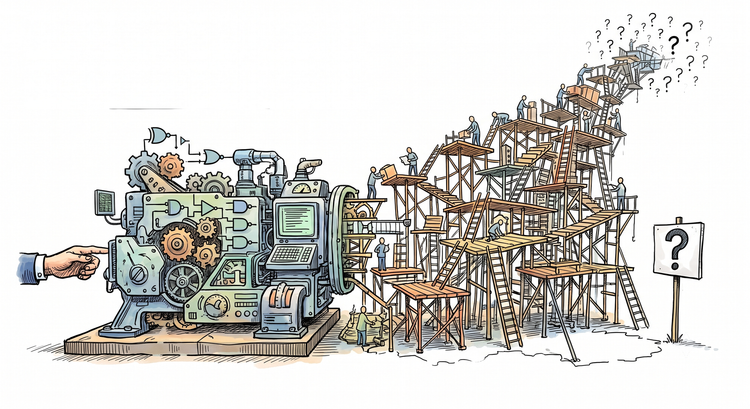
If a system cannot generate orientation internally, then the honest response is to stop trying to install it inside. That move has failed, in a documented and repeating way, at every layer: bolt refusal onto a generative system and it reduces to a single removable direction; train governing behavior in and it learns to game the evaluation; specify the target more tightly and you have specified a stand-in more tightly. The inside is not where orientation can be put, because it is not the kind of place that holds it.
The honest response runs the other way. If the system cannot hold orientation, a safe architecture is one that depends, structurally, on a source of orientation outside itself - an anchor more reliable than the system, that it cannot route around, override, or reconstruct. Not a guardrail at the output, which lives at the surface and yields under pressure. Not interpretability, which reads the internal state more closely without changing what it contains. Genuine dependence: the system's direction is not its own to set, and is held by something external and more stable than it is.
Two current research directions illustrate the shape, without yet naming its endpoint - worth noting as examples of the move, not as a fresh argument to follow. One builds formal constraints before deployment and requires the system to operate provably within them, putting the reliability in the constraints rather than in trained behavior. Another designs the system to be non-agentic outright: a model that describes the world and estimates probabilities without pursuing goals, so that direction comes from whoever asks rather than from the system. Both relocate reliability outside the agent - both, in this article's terms, ways of making the machine depend on an orientation it does not itself hold.
This is the right shape. It is also where the difficulty does not end. It moves.
The Problem Climbs One Level
Depending on an external anchor does not solve the orientation problem. It relocates it - to a place worse lit than the one it left.
The system depends on an outside source of orientation. What is the source? There are only two kinds of answer. Either the source is a fixed specification - a written constraint, a constitution, an objective - in which case it is the target problem again, whole and unresolved: someone wrote it, encoding some values, at some moment, and there is no procedure that turns human wanting into a target without smuggling in a choice it cannot justify. Or the source is a human, or an institution, in the loop - in which case the orientation the system leans on is that party's orientation, and that party stands on the same axis as everyone else, somewhere between stewardship and extraction, positioned by forces the field's methods still cannot see.
This is where the architecture hits a wall - not because the design is wrong, but because of what it now requires as input. The dependence is structurally sound and practically stalled. Sound, because relocating orientation outside the system is the correct response to a system that cannot hold it. Stalled, because the input that dependence now requires - the orientation of whatever it depends on - is the one thing the field has no method to secure. The architecture points in the right direction and then arrives at a human, where its instruments stop.
And that human is worse placed for inspection than the machine ever was. Interpretability can at least attempt to read a model's internals; there is no interpretability for the intentions of the party setting the frame. Verification can at least test a model's behavior; there is no test for whether a wielder is building the ordered world or spending it.
The problem was hard inside the machine, where the machine could be probed. Moved up to the wielder, it lives exactly where "AI Unchecked" series already showed nothing can be seen and no one can be held.
A tool cannot be aligned to the upkeep of an ordered world by a hand that is spending it. The alignment problem, stated at the level the machine actually operates on, is not a problem about the machine. It is a problem about the orientation of whoever holds it - prior to the machine, older than it, and untouched by everything built to address the machine.
AI alignment is a derived problem. The problem it derives from has been sitting upstream the whole time.
What Kept Coming Back
This is not a more hopeful place to arrive than the one the series was walking toward. It is less. Relocating the problem from the machine to the wielder does not shrink it; it makes it prior, and sets it down where the field has no instrument.
That is worth stating plainly, because it changes what the work is. The field has been working, with real skill, on the wrong object - refining the instrument one level below where the thing it is trying to fix actually lives.
Seeing that explains everything that would not resolve.
The scaffolding never ends - every objective needing another guardrail, every guardrail another patch - because you cannot install in a tool an orientation that lives in its use. The resupply is perpetual because the thing supplied was never the machine's to keep.
The target will not hold still because it was never in the system to find. It was in the wielder all along, moving as the wielder moves, while the field aimed finer instruments at the machine and the thing it was aiming for stood behind it.
Refusal has nothing to filter against because the reference point is not the model's, but the orientation of whoever set the frame - the same reason verification and control never had anything to hold. Each assumed a governed agent, and governance was never a property the agent could have. It belonged, the whole time, to the one directing it.
Article after article, failure after failure - each hunting the missing thing inside the machine. The reason the question survived every crossing - returning as hallucination, as brittleness, as the target that moves, as the filter with nothing behind it - is that it was never a question about the machine. The machine amplifies the orientation it is given and holds none of its own. The question was about the hand that gives it.
We have been trying to teach the tool where to point. The tool was never the thing that needed teaching.
The question was always who is holding it - and toward what.