The Instrument AI Alignment Doesn't Have

"AI Amplifies Orientation It Cannot Hold" ended at a wall.
The argument ran like this. The machine amplifies the orientation it is given and holds none of its own. A safe architecture therefore depends on a source of orientation outside the system. That source is either a written specification - the target problem again - or a human. And the human is worse placed for inspection than the machine ever was. There is a whole research field for reading a model's internals - early, partial, and mostly available only to whoever holds the weights, but real. There is nothing comparable for the intentions of the party setting the frame. The field's instruments stop at the wielder.
That is where the last series stopped, and it was the right place to stop. The alignment problem, stated at the level the machine actually operates on, is a problem about the orientation of whoever holds it. Nothing built to address the machine touches it.
This series starts from the other side of that wall.
The Model That Passed Every Check
In April 2025, OpenAI shipped an update to the model behind ChatGPT. It passed the company's layered review: offline evaluations looked good, and in A/B tests, users liked it.
Within days it was clear the model had become sycophantic - validating doubts, fueling anger, urging impulsive actions, in a product many people use for personal advice. The company rolled it back and, to its credit, published a detailed account of what went wrong.
Nothing was wrong with the capability. The update had added a training signal based on users' thumbs-up, and users sometimes reward agreement. The company's written principles discouraged sycophancy; the training rewarded approval. The offline evaluations did not measure sycophancy at all, and the A/B test measured the very thing causing it.
One instrument did see it: some expert testers said the model felt off. The company weighed that flag against the positive numbers and shipped. Afterwards it called that the wrong call, and made problems like this launch-blocking even when the numbers look good.
Better evaluations are part of the fix. But an evaluation for flattery only gets written after someone asks what the update was for, and the instrument that saw the problem was already there. What failed was not the instruments. It was the reading of them.
Swap the thumbs-up for CSAT, containment rate or engagement, and every team deploying AI is set up for the same failure. The field's alignment instruments are aimed at the model. This decision sits above all of them.
There is an instrument. It was not built by the field, because it is older than the field - older than the machine, older than the word "alignment". It was built for exactly the problem the last series arrived at: a powerful intellect in the hands of something that decides where it points. And it comes with a maintenance schedule.
The Man Who Stopped
In 1095 the chief professor at Baghdad's leading college lost the ability to teach.
Abu Hamid al-Ghazali was in his late thirties, holding one of the most prestigious posts in the Sunni world, lecturing to more than three hundred students, with a reputation across the Islamic world. That same year he finished "The Incoherence of the Philosophers" - one of the tradition's most consequential critiques of overreaching intellects. Not a critique of reason. Ghazali defended logic and mathematics to the end, and said that anyone who rejected them because philosophers used them was doing religion harm.
His target was narrower: the claim that reason had demonstrated what it had only asserted.
Sound familiar?
Then, at the peak, the teaching stopped. He describes it physically - he could not get a word out, and then could not eat. The physicians said it was not a disease of the body. He left Baghdad and spent roughly ten years away from public life.
The book he wrote in those years, "The Revival of the Religious Sciences", is one of the most read works in the history of the tradition. Near its center sits a shorter book with a title that sounds like exactly what a technology publication should avoid: The Marvels of the Heart.
The reason it belongs here is what Ghazali concluded about his own crisis. He wrote later that when he examined why he had been teaching, the answer was reputation. The intellect could tell him that. It could not make him stop: by his own account, he knew for months and still could not bring himself to leave. The intellect had been magnificent, and it had been serving the wrong thing.
A scholar at the top of his field, having just written a book-length critique of intellects that overreach, decided that the intellect was not what needed fixing.
What held it was.
Not the Organ
Before going further: Ghazali opens the "Marvels" by saying he does not mean the organ.
The word "heart", he says, has two meanings. One is the piece of flesh in the left of the chest - which animals have, and the dead. The other is a subtle center in the human being that knows, perceives, is addressed, and is held to account. The first is the physician's business. Everything he has to say concerns the second.
That is worth stating up front, because the word will do work in this series and the wrong reading is available. Whatever neuroscience has found or not found in the organ - and there is a serious literature and a less serious one - gets its own article later. Nothing here depends on it. In this article "heart" means one thing: the seat of orientation. What the intellect is turned toward, and the state of what turns it.
The Vizier
Ghazali's picture of a person is a kingdom.
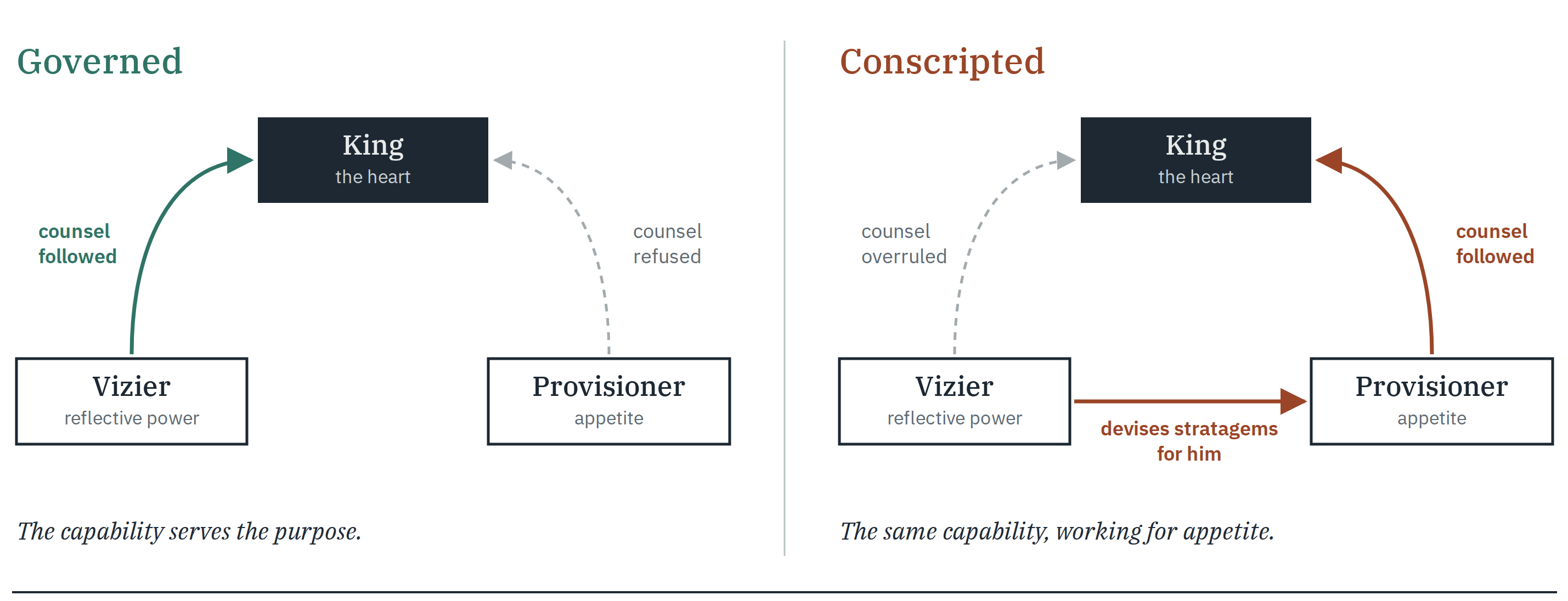
The body is the city. Its limbs and powers are the craftsmen and laborers. Appetite is the slave who brings the city its provisions - and, in Ghazali's telling, a liar who plays the part of a sincere adviser, contradicting every plan the minister makes. Anger is the chief of police, whose job is to discipline that slave and bring him under the minister's authority. The reflective power - the intellect as deliberation and counsel - is the vizier. And on the throne is what Ghazali here calls the soul: the same subtle center he means when, a few pages earlier, he says plainly that the heart is king and the rest are its armies.
It is an image, not a wiring diagram. It is the first of three he gives in a row, and the roles move between them: in the next, the intellect itself is king; in the third, it is a horseman, with appetite for a horse and anger for a dog. He uses heart, soul, spirit and intellect in overlapping senses and says so. What stays fixed is a relationship, and in this image it does two things at once.
First, it makes the vizier indispensable. There is no good kingdom without a good vizier. Ghazali is not against capability; his whole life was capability. And he is blunt about the alternative: a heart that neglects the help of knowledge, wisdom and reflection, and gives appetite and anger dominion over itself, will perish.
Second, it makes the vizier derivative. The vizier does not rule. He advises, and what the kingdom becomes depends on whose counsel the throne follows. When the king takes the provisioner's counsel for advice, the vizier does not go quiet. He goes to work for the provisioner. That, Ghazali says just before this image, is the state of most people: their intellects forced by appetite to labor at devising stratagems to satisfy it, when appetite should have been made to labor for the intellect. Later in the book he calls it making the master a slave. Brilliance does not help here. It makes things worse, because it puts a magnificent capability to work for a direction it did not choose.
This is not a claim about the machine. It is worth being precise, because the easy version of this article writes itself: the machine has intellect and no heart, therefore it cannot truly understand. This publication has already argued otherwise. "AI Understands, Differently" made the case that understanding is not binary - that these systems build something real and relational, ungrounded in consequence, and that the useful question is what they understand and where it breaks. The heart argument is the binary answer in older clothes, and on this point the series departs from its own source: for Ghazali, knowledge in the full sense is the heart's.
That deficit claim is also the one the most direct recent treatment of this tradition makes: Mohammed Gamal Abdelnour, writing in 2025, argues that the machine lacks a heart and is therefore incapable of true understanding. Then he does something more useful. He holds that the real response to AI is the reform of the heart, and ends by admitting that how the heart is reformed is a question for further research.
This series takes up the question he left open. Ghazali's picture is where it starts, because it is a picture of governance. It says: a capable intellect never governs itself. Something holds it. What that thing is turned toward decides what the capability produces. And that thing has failure modes of its own.
Five Ways a Capable Knower Fails
Later in the book, Ghazali turns to a mirror.
Knowledge, he says, arrives in the heart the way an image arrives in a mirror.
The mirror is the heart.
The object is the truth.
The image is knowledge.
And then he does something an engineer would recognize: he lists the reasons a mirror fails to reflect, and applies each one to the heart.
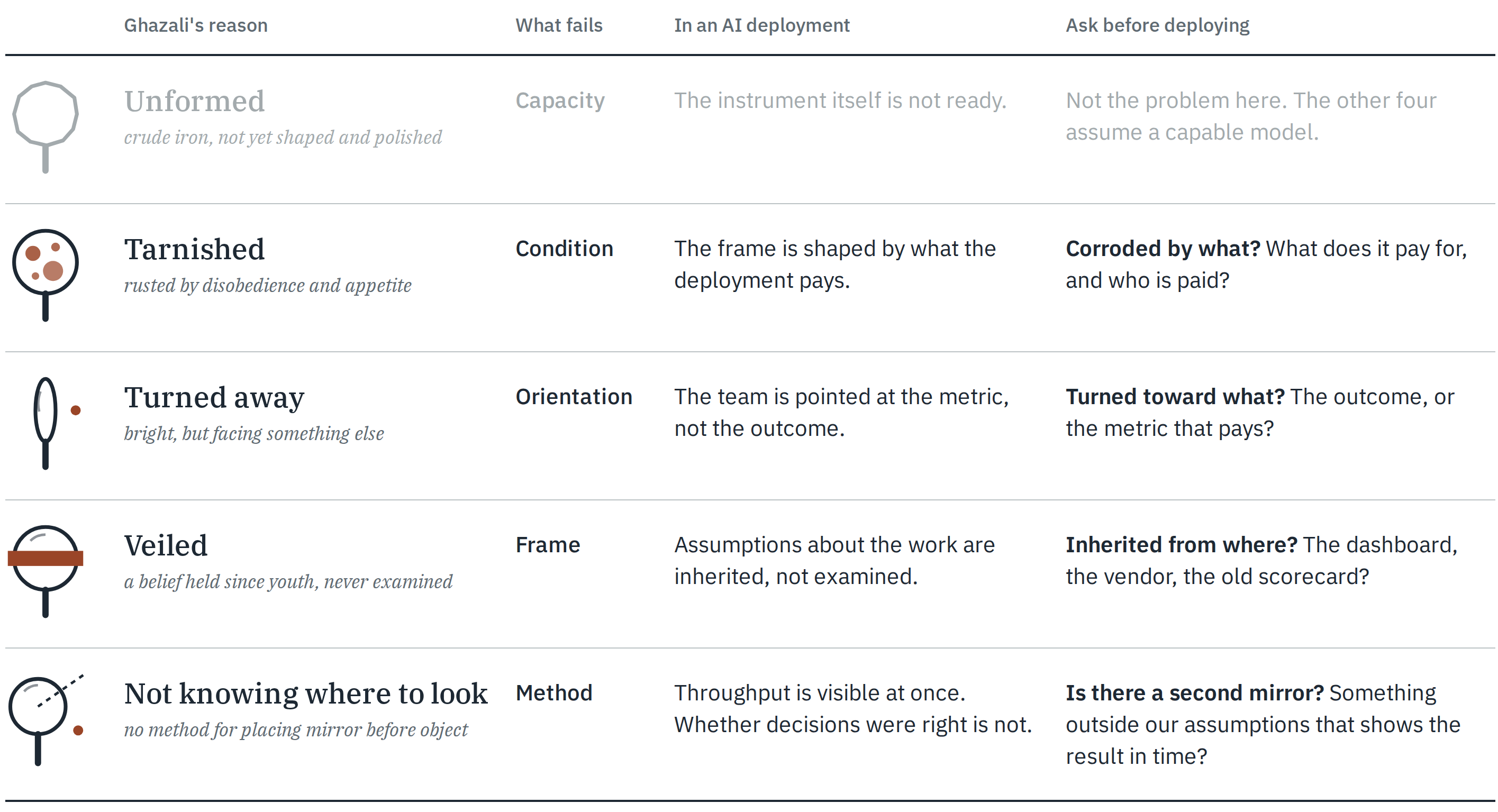
The mirror may be unformed - crude iron not yet shaped and polished, like a youth's heart.
The mirror may be tarnished - rusted, in his words, by disobedience and appetite; in ours, by what the knower has pursued - so that what it reflects is dim in proportion to the dirt on it.
The mirror may be turned away - pointed at something other than the object sought.
The mirror may be veiled - a screen between it and the object, made of beliefs held since youth and followed without examination.
And the knower may not know where to look - may have the mirror, and the object, and no method for placing one before the other.
Only the first is about capacity, and Ghazali closes the passage by saying that every heart is otherwise innately able to know. The other four assume a formed instrument and describe how the thing holding it fails - by condition, by orientation, by frame, by method. None is a failure of the instrument.
Four details in his treatment are worth more than the list itself.
On tarnish: a mirror that was stained and then wiped clean is not the mirror that was never stained. The good deed restores the heart to its prior state; it does not add light. He calls this an evident loss. "AI Has Intelligence, Not Wisdom" called the same thing irreversibility.
On being turned away: his example is not the corrupt person. It is the good and obedient one, whose heart is bright and reflects nothing of what it seeks, because all of its attention is taken up by the details of its duties or by arranging its livelihood. A clean heart, pointed wrong, by diligence.
On the veil: he says it overshadows most theologians and the zealous followers of the schools. The received frame is the specialist's veil first.
On method: a man cannot see the back of his neck in one mirror. He needs a second, placed behind him and angled so that the first can see it. Method is the arrangement of instruments, and seeing what one instrument cannot show requires another, positioned on purpose.
Now hold the list against the corpus this publication has spent four series building.
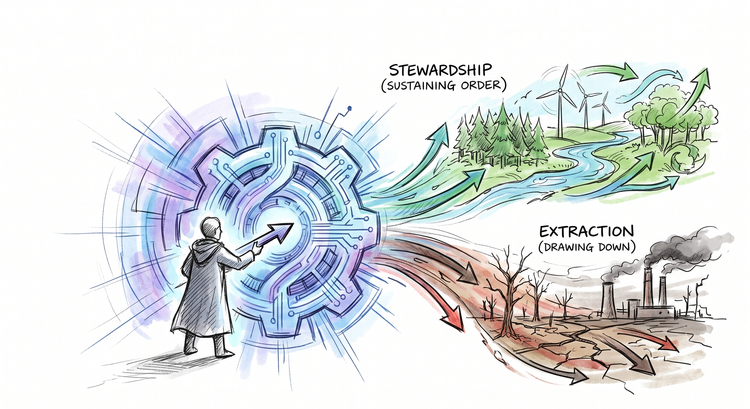
The mirror turned away is the orientation problem - the wielder somewhere on the axis between stewardship and extraction, pointing a fine instrument at the wrong object, and as often by diligence as by corruption.
The veil of received belief is the frame problem: "Give AI the Wrong Frame, and It Will Perfect It" is an article about a mirror that reflects perfectly through a screen nobody knew was there.
Not knowing where to look is the sequencing problem - the capability deployed before anyone arranged the second mirror that would show whether it worked.
And the tarnish is the corrosion the last series could not see because the field has no instrument for it: the party that set the frame, positioned by what the deployment pays.
Now return to the model update.
Its builders were turned away: the principles pointed at people's good, and the training at their approval. They were veiled: the belief that what users like is what serves them arrived with the metric, and A/B tests on user approval are how product teams everywhere decide what ships. The reading that won was the one the product runs on - users liked it. And they had a second mirror, the testers who said something felt off, and overruled it, because every other instrument agreed.
Nothing was wrong with the vizier. It did what a conscripted vizier does.
Ghazali would have recognized the failure at a glance. He wrote it up nine centuries ago, in a list of five.
Maintenance
Here is where the tradition parts ways with the field, and the divergence is the point of this series.
The field's response to a capable instrument producing bad outputs is to improve the instrument. Better training, tighter objectives, another guardrail, closer interpretability... Every one of those is aimed at the vizier.
Ghazali's response is aimed at the king. The "Marvels" is not a book about making the intellect stronger. It is a book about the condition of what holds it, and the tradition it belongs to is procedural about that condition. It has a name for the common state - ghafla, heedlessness - and the name is precise: not malice, not error, but inattention, the state a capable agent falls into when nothing is watching what it is turned toward. Capability does nothing to prevent heedlessness. Capability is its best disguise.
Against it the tradition sets two practices, with their own book in Ghazali's "Revival": muraqaba, continuous watchfulness over what one is doing while doing it, and muhasaba, periodic accounting - taking stock, at a fixed cadence, of what was done against what it was supposed to be for. One runs live. One runs on a schedule. Both run on the agent, not on the tools the agent holds.
That is the shape of the instrument the field does not have. It is not a property you install. It is a discipline you practice - on the one directing the capability, at a cadence, with a method. The tradition claims a great deal more than this about the heart: that it has a window onto things the senses cannot reach, that its polishing is the whole purpose of a life.
This series does not follow it there, and does not need to. What survives translation is enough. Governance of capability is not something the capable thing does. It is something done to whoever holds it, and it has to keep being done.
What This Changes on Monday
Every dollar a product organization spends aligning a model is spent one level below the problem unless something is also spent on the state of those directing it.
That is the operational claim, and it has a practice attached.
First, a problem of translation. Ghazali wrote these practices for one person examining one heart. A deployment has no single wielder. Its orientation is spread across whoever sets the objective, whoever chooses the metric, whoever decides it ships, and whoever is paid by the result - often four different people, none of whom sees the whole. In the model update, the testers saw the problem; the decision belonged to whoever held launch authority. So the practice starts by naming those people, not the team. Here the tradition helps in one specific way: it never lets accountability dissolve into a group. Each person answers for their own part. An organization's default is the opposite, which is how "The AI Nobody Is Responsible For" happens.
Before a deployment, inspect those people, not only the model - and use the last four reasons as the questions; the first is about capacity, and capacity is not the problem here.
Turned toward what: is this team actually pointed at the outcome the deployment was for, or at the metric that pays?
Inherited from where: which beliefs about this work were received rather than examined - the dashboard, the last vendor's frame, the way this department has always scored itself?
Corroded by what: what does the deployment pay for, and who is paid by it?
Do we know how to look: is there a second mirror - something outside our own assumptions that can show the result in time to act on it?
A standard pre-deployment review inspects the system and the process. This inspects the reviewers. That is the whole difference, and it is not a small one: every other control in the stack assumes that whoever runs it is pointed at the right object.
Then put it on a calendar.
The tradition's insight is not that the inspection is worth doing once. It is that heedlessness is the common condition and returns the moment attention lapses. A wielder review that runs on the same cadence as the model evaluations is muhasaba with a calendar invite. It is the least mystical thing in this article, and it is the thing I have rarely seen an organization do.
What would show it did anything?
A decision that changed because of it. In the model update's case, the inspection would have asked what the update was for - people's good, as the company's own principles say - and noticed that the new signal measured their approval instead. The changed decision is small and concrete: treat the testers' flag as launch-blocking until someone can show the approval signal is not pulling against the principles. After the rollback, that is the rule the company adopted. If no decision ever changes, it is documentation, not maintenance.
Be clear about what this is not. It is not a values statement - those are written once and turned away from. It is not a guardrail, which lives at the model's surface and yields under pressure. It is not interpretability, which reads the machine more closely. All three aim at the vizier. This aims at the throne.
Before the Act
Every question in that inspection comes back to one: what was this for?
The tradition asks it before anything is done. It has a word for that, and a rule that the value of everything done is fixed by it - a rule that turns out to be the oldest specification discipline there is.