The Loop AI Empties
For decades, one safety model has stood between automated systems and the decisions that matter: keep a human in the loop.
The machine produces an output. A human reviews it, corrects it, approves it.
The system contributes speed and scale; the human contributes judgment and accountability. Every serious framework for deploying AI in consequential settings rests on some version of this arrangement. It is the reflex answer to every worry about these systems. A checkpoint. A signature. A loop.
The model deserves more scrutiny than it gets, because of what was actually holding it together. It was never human vigilance. It was something quieter, and current AI has removed it.
What the Old Model Actually Ran On
Consider what human-in-the-loop looked like for most of its history.
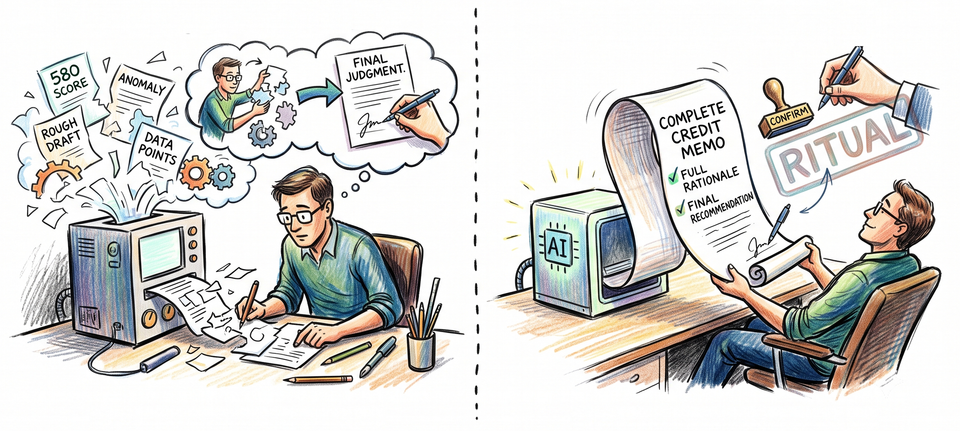
A statistical model flags a transaction as anomalous - a score, a threshold crossed, nothing more. A translation system produces a draft full of visible awkwardness. An early decision-support tool returns a number without a rationale, a classification without a case. The output was useful and plainly unfinished. It arrived wearing its own limitations on the surface: fragmentary, stilted, stripped of context... That visible incompleteness was not a flaw in the arrangement. It was the load-bearing element.
An output that is legibly deficient summons judgment. The reviewer cannot simply accept it, because there is nothing whole to accept - the gap between what the machine produced and what the decision requires is right there on the page, and closing that gap is work only the human can do. The anomaly score demands an investigation. The rough draft demands a rewrite. The bare number demands a case built around it. The human's judgment was not a policy the organization hoped would be exercised. It was structurally required, every time, by the shape of what the machine handed over.
This is the quiet assumption underneath every human-in-the-loop design: that the machine's output would keep announcing what it lacked. The model never actually depended on humans staying alert. It depended on the output keeping them alert - on deficiency legible enough to make judgment unavoidable.
Then the output stopped announcing anything.
The First Complete-Looking Version
Current AI does not produce fragments, scores, or stilted drafts. It produces the memo already written. The assessment already reasoned. The recommendation already confident, already structured, already in the exact form the reviewer's own finished work would take.
Being precise about what this is, because the precision matters - and it runs deeper than polish. The system has not acquired judgment: it has fluency without wisdom, capability without any stake in the outcome. But two different things arrive together in its output, and they should be named separately.
The first is extraordinary fluency - the form of judgment: complete sentences of rationale, weighed-sounding tradeoffs, a conclusion that follows from a case.
The second is harder to dismiss: functional completeness. On the typical case, the memo is not merely styled like the decision - it is most of the decision, actually assembled, and usually right.
If the danger were only gloss, the fix would be training reviewers to see through it. There is nothing to see through. What remains missing is what was always missing - the stake in the outcome, and the wisdom about the exception: the unearned confidence, the plausible reconstruction where grounded knowledge should be, the priority quietly resolved that should have been surfaced.
And the exception is precisely what the reviewer was placed in the loop to catch.
Picture the loan file. An underwriting assistant drafts the full credit memo: the applicant's history summarized, the ratios computed and interpreted, the risk factors listed and weighed, the recommendation stated with its reasons. The reviewer of a decade ago received a score and built the case themselves. This reviewer receives the case - coherent, professional, indistinguishable in form from the memo a competent colleague would write. Somewhere in it, perhaps, a debt-to-income figure interpreted through an assumption that does not fit this applicant's situation. Nothing flags it. The memo reads as finished because reading as finished is precisely what the system is best at.
The old output said: I am partial, complete me.
The new output says: I am done, confirm me.
Those are different requests, and they summon different things.
Review Collapses into Revision
Reviewing an incomplete output and reviewing a complete-looking one are not the same cognitive act, and the difference is where the safety model quietly gives way.
Faced with a fragment, the reviewer must construct the judgment themselves - gather the context, weigh the factors, build the decision from the ground up. The machine's contribution is raw material. The human's contribution is the decision.
Faced with a complete-looking artifact, the task inverts: the decision, to all appearances, already exists. What remains is to check it - and checking a finished-seeming thing means working within it. Its framing of the problem becomes the framing. Its selection of relevant factors becomes the relevant factors. Its conclusion becomes the anchor every adjustment is measured against.
In "Give AI the Wrong Frame, and It Will Perfect It", the danger ran one direction: systems perfect whatever frame they are handed. Here the arrow reverses. The fluent draft becomes the frame the human operates within. The reviewer who was placed in the loop to stand outside the machine's output - to judge it against the world - now stands inside it, adjusting at the margins of a structure the machine supplied. The loop was designed so the human would evaluate the machine.
Fluency quietly rearranges it so the machine's output organizes the human.
And so the drift begins, in a sequence anyone who has watched these deployments will recognize. At first the human edits heavily - the loop working as designed. The system improves. The edits find less to change. Approval comes faster. Assumptions get questioned less, because the assumptions arrive pre-ratified by their own coherence - and because they are, on the record so far, usually sound.
The draft becomes the starting point. Then the reference point. Then the new normal. The shift from this needs work to good enough happens gradually, then all at once.
An Old Mechanism, a New Material
None of this is a novel discovery about human nature. It is worth saying so plainly, because the objection is legitimate: automation researchers have documented this pattern for over forty years. Lisanne Bainbridge's classic analysis of the ironies of automation, published in 1983, laid it out - the more reliable the automated system, the worse the human overseer becomes at supervising it, because vigilance atrophies without exercise and skills decay without use. The human left to monitor a system that rarely fails is being asked to do something humans are demonstrably bad at. Aviation learned this. Process control learned this.
The finding is old and it is solid. What is new is not the mechanism. It is the material the mechanism now works on.
The automation Bainbridge studied produced output that never resembled human judgment - gauges, alarms, control adjustments. The human's atrophying vigilance was vigilance over dials. When the human failed, they failed to notice a reading; the machine's output and the human's judgment remained visibly different kinds of thing, and no one mistook one for the other.
Fluent AI collapses that distinction. The reviewer is not monitoring a dial. They are judging an artifact shaped exactly like their own judgment, produced faster and more confidently than they could produce it themselves.
And the domain has changed with the material. A lapse in vigilance over a pressure gauge endangered a process. The loops being automated now sit inside the machinery of institutions - the symbolic layer where records, statuses, eligibilities, and approvals are decided. The old irony of automation degraded a human's oversight of the physical world. The new one degrades a human's judgment of judgment-shaped artifacts, in the layer where decisions allocate reality.
Same mechanism. Different stakes entirely.
The Loop Converts
Follow the eroded loop into the institution, and something stranger than failure appears.
Workflows do not end in text. They end in a changed record, an updated status, an approval granted - the claim denied, the benefit cut off, the case flagged, the application rejected. When the reviewer approves the fluent memo, the approval is not a reading experience - it is an institutional event. And attached to that event, every time, is the artifact the safety model exists to produce: the human signature. Reviewed and approved. The loop's paperwork is impeccable, because the loop is still physically there - a person, a checkpoint, a sign-off, exactly as the framework requires.
What has changed is what the loop produces. It was built as a judgment-producing mechanism: the point in the process where a human mind actually engaged the decision. As the judgment drains out, the loop does not shut down. It converts - into a defensibility-producing mechanism. Every decision emerges certified. The record shows human oversight on each one. The oversight it records has thinned to a glance, but the record cannot show that; thinness leaves no trace in a signature. The institution is not lying. It is documenting a control that has quietly become a ritual, and the documentation is indistinguishable from the real thing.
"The AI Nobody Is Responsible For" found that when these systems fail, accountability has nowhere to land. The eroded loop resolves that problem in the worst available way: it gives accountability a place to land - formally, cleanly, on the signing human - while hollowing out the activity that made the assignment meaningful. Accountability stays assigned to someone who is no longer actually doing the job it requires. The org chart is satisfied. The audit is satisfied. The one thing the arrangement was built to guarantee is the thing it has stopped guaranteeing.
This is why the erosion is so hard to see from inside - no incident, no breach, no day the judgment left. A failed safeguard announces itself eventually. A converted one never does: it keeps generating evidence of its own success. The better the AI performs, the faster the approvals, the cleaner the metrics, the more intact the loop appears. Every signal the institution watches improves as the substance leaves.
The Questions Underneath the Checkbox
None of this argues that AI should be kept out of consequential workflows, or that the humans in these loops are failing at their jobs. The people approving faster are responding rationally to what is in front of them: output that is usually right, always fluent, and shaped like a finished decision. The erosion is not a character flaw. It is what happens when a safety model built for legible deficiency meets output engineered - by nothing more sinister than optimization for quality - to display none.
But it does mean the reflex answer has stopped answering. "There's a human in the loop" now describes an arrangement, not a guarantee. Whether the arrangement still contains what it was built to contain has become a separate question - one that has to be asked deployment by deployment, and that almost no one is asking, because the checkbox is checked and the signatures are on file.
Two questions sit underneath the checkbox, and they are harder than the one it answers.
The first: should this part of the system be assisted this way at all - is this a decision where the first complete-looking version should ever arrive from something with no stake in the outcome?
The second, wherever the answer is yes: is the workflow designed to preserve the human's judgment - or does it place the human in direct competition with the machine, in symbolic space, the one arena where the machine is fastest, most fluent, and most convincing?
Institutions deploying these systems are, mostly without noticing, answering both questions by default. The defaults all point the same direction: toward the draft first, the human after.
The safety model everyone cites is the one that empties as the AI improve - the better the machine performs, the more intact the loop looks, and the less it contains.
The loop was built to hold judgment. What it holds now is the record of it.